


Across Asia-Pacific, carbon capture is moving from isolated demonstration projects toward practical climate infrastructure: industrial clusters, CO2 terminals, shipping routes, offshore storage wells and new pathways for turning captured carbon into useful materials.
This week's signal is that the technology challenge is no longer only about capturing CO2 at a smokestack. The harder work is building the system around it: transport, storage appraisal, financing, regulation, verification and markets that can make captured carbon either permanently stored or commercially useful.
Australia's first carbon refinery is converting CO2 captured from ammonia production into materials for concrete, paper and glass, showing how carbon capture can become an industrial input rather than only a disposal problem.
India's planned carbon economy is taking shape around a Rs 20,000 crore CCUS push, linking industrial decarbonisation with technology development, carbon utilisation and future carbon-credit markets.
INPEX has started appraisal drilling for a Greater Tokyo Area CCS project, testing offshore formations that could store CO2 from steelmaking and industrial emitters around one of Japan's largest economic regions.
Kelington and PETRONAS CCS Solutions are studying satellite CO2 terminals, a midstream piece of the value chain that could receive, temporarily store and transfer liquefied CO2 for utilisation or permanent sequestration.
The Republic of Korea is investing in demonstrations that turn captured CO2 into e-SAF, synthetic gas and marine fuel, linking carbon utilisation with domestic alternatives to imported fuel and industrial feedstocks.
Indonesia and Singapore are exploring cross-border CCS, pairing Singapore's limited storage options with Indonesia's large geological capacity and highlighting the regulatory questions around shipped CO2, ownership and liability.
Singapore's ocean-based carbon removal plant points to a different form of sequestration: using electricity and seawater chemistry to lock carbon into stable mineral forms while testing whether ocean CDR can scale safely.
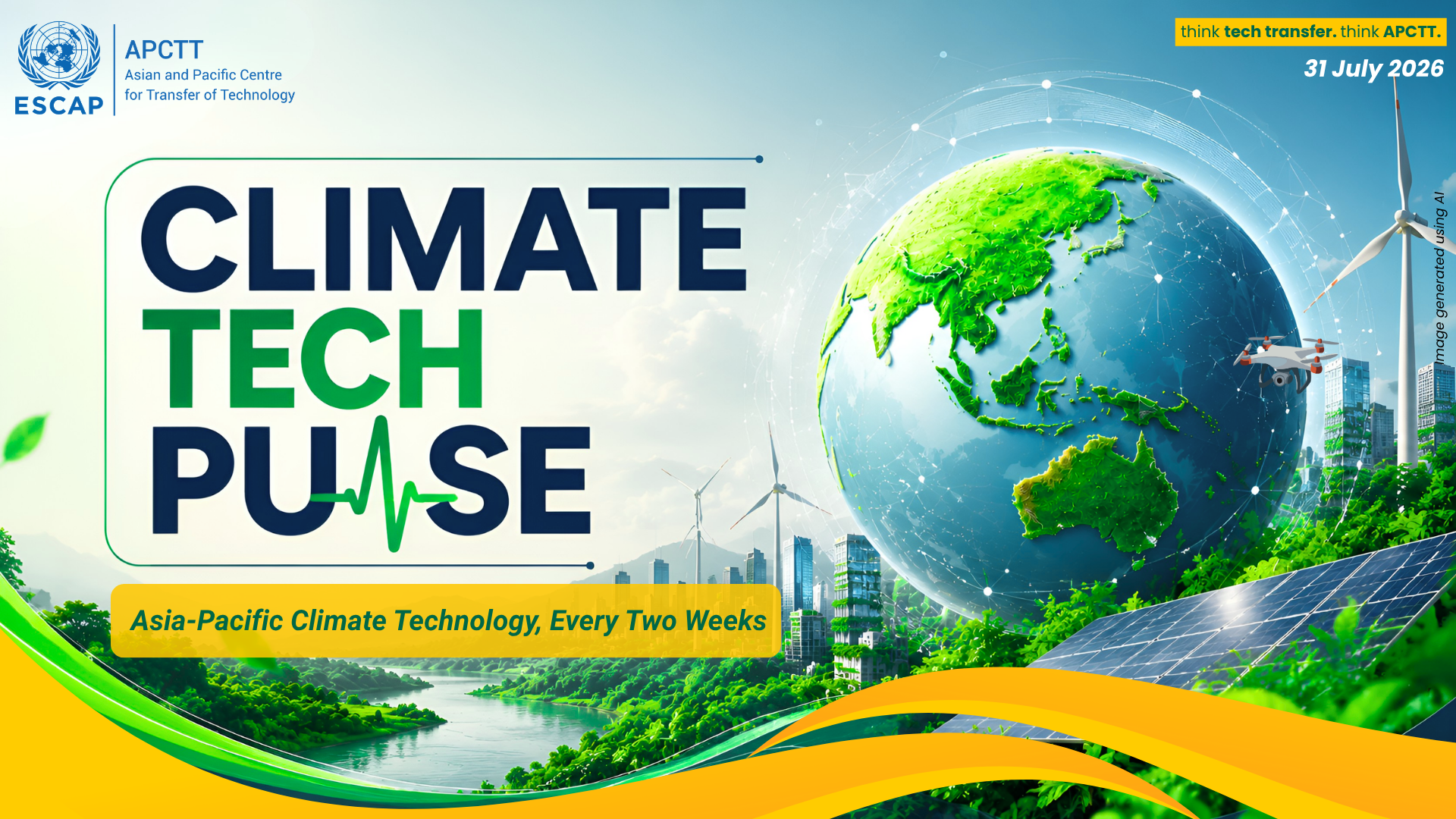
Climate Tech Pulse is a biweekly compilation of web-based news and information on climate technologies across Asia and the Pacific.
Technology offer
Interested in this technology?
Request further information or explore potential cooperation with the technology provider.
Technology request
Can you help meet this technology need?
Share a relevant technology, expertise or partnership opportunity with APCTT.