

GreenTech Transition and Financial Innovation: Emerging Mechanisms for Sustainable Development


The transition to low-carbon and climate-resilient technologies requires innovative financing solutions to address challenges such as high upfront and operational costs, limited access to funding, technological and investment risks, and concerns about impact assessment and verifiability. We explore how emerging financing instruments, including sustainability-linked loans and bonds, blended finance, asset tokenisation, and blockchain-enabled financing, are driving the adoption of green technologies in the Asia-Pacific region. Drawing on case studies from energy-efficient data centres, renewable energy infrastructure, energy efficiency solutions for Small and Medium Enterprises (SMEs), and digital green bond issuances, the article highlights how performance-based financing, public-private risk-sharing, and IoT-enabled verification can reduce financing barriers and mobilise capital. The findings suggest that innovative financing frameworks can accelerate adoption of sustainable technology, while supporting industrial competitiveness under evolving regulations such as the European Union’s Carbon Border Adjustment Mechanism (CBAM). In conclusion, we highlight the need for harmonised taxonomies and supportive policies to scale sustainable finance across Asia-Pacific economies.
- climate change
- green technology
- sustainability-linked loans
- blended finance
- asset tokenisation
1. Introduction
Growing climate risks and extreme weather events pose significant challenges to sustainable development. The Asia-Pacific region, accounting for more than half of global greenhouse gas emissions, includes some of the world's most climate-vulnerable economies, with projected temperature increases and sea-level rise expected to exceed global averages under a high-emissions scenario (Asian Development Bank, 2024). Limiting global warming to 1.5°C requires greenhouse gas emissions to be reduced to nearly half by 2030, with the largest emitting countries expected to make the most substantial reductions (United Nations Environment Programme, 2024). Achieving this transition will require widespread adoption of low-carbon and climate-resilient technologies. It is projected that around USD 9-10 trillion is required annually to finance this transition. However, the economic costs of delayed action are likely to be far greater, including losses from stranded assets, climate-induced migration, and rising adaptation and mitigation expenditures (Buchner et al., 2023). Yet, mobilising finance remains a primary bottleneck for scaling up climate-resilient technologies.
Historically, climate finance has been largely driven by public sources such as supranational organisations, national governments, and development banks. Nationally Determined Contributions (NDCs), pledged under the Paris Climate Agreement, have further strengthened the resolve to finance the transition, yet an estimated USD 6 trillion is required by 2030 to meet these targets (United Nations Development Programme, 2025). Bridging this gap will require the effective mobilisation of private capital alongside public finance. While climate policy uncertainty and investment risks remain challenges in attracting private capital, financing this transition is also increasingly seen as an important investment opportunity. Effective policies can play a key role in making investments in low-carbon technologies commercially viable through subsidies and tax incentives. Given the long gestation periods of these projects, mechanisms such as feed-in tariffs and guaranteed prices can provide revenue certainty, while de-risking instruments, such as first-loss guarantees, can protect investors against potential losses, thereby making GreenTech investments more attractive to private capital (Koerner et al., 2022; McKinsey, 2023). Further, sustainability outcomes need to be tied to actual investments to enhance credibility and attract greater investor participation (Asian Development Bank, 2024).
Innovative financing instruments, such as sustainability-linked bonds and loans, blended financing, performance-based financing, and tokenised bonds, have emerged as important mechanisms for addressing these challenges and mobilising capital towards green technology investments. This article examines financial instruments through four case studies that demonstrate their role in mobilising capital for green technologies. The following sections provide an overview of emerging innovative financial instruments, followed by four case studies from the Asia-Pacific region. The article then discusses key challenges and opportunities, presents policy recommendations and a conceptual framework, and concludes with final remarks.
2. Innovative Financial Instruments
2.1. Sustainability-linked Bonds (SLBs)
Sustainability-linked bonds (SLBs) are an innovative sustainable finance instrument where the financing costs of the bond or other financial characteristics are linked to specific sustainability performance targets. Unlike traditional green bonds, which include use-of-proceeds clauses that restrict funds to eligible green projects, SLBs do not impose such restrictions. Instead, the bond's financial terms are linked to the achievement of predetermined key performance indicators (KPIs) within a specified timeframe (Organisation for Economic Co-operation and Development, 2025). If the issuer fails to meet these targets, the coupon rate generally increases, whereas meeting the targets may result in more favourable financing terms. This structure directly links financing incentives to sustainability outcomes while providing greater flexibility in capital use. This makes SLBs particularly useful for firms in transition-intensive sectors where sustainability improvements require broader operational changes rather than investment in a specific green project.
Source: Climate Bonds Initiative
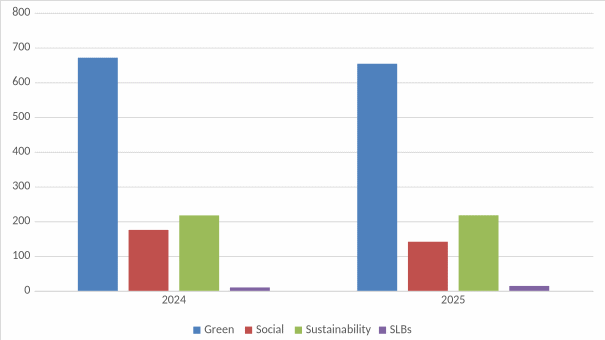
Sustainability-linked bonds are still at a relatively early stage of development, with the first SLB issued by the utility company, Enel, in 2019 (Vulturius et al., 2024). Figure 1 illustrates the global issuance of green, social, sustainability, and sustainability-linked bonds over the last two years. Green bonds continue to dominate the sustainable bond market, accounting for approximately 64 per cent of total issuance in 2025. Sustainability-linked bonds have also witnessed steady growth, with annual issuance increasing from around USD 9.6 billion in 2024 to USD 14 billion in 2025, representing a 46 per cent YoY increase (Climate Bonds Initiative, 2026).
2.2. Blended Finance
Blended finance refers to the strategic use of public and philanthropic capital to mobilise private capital towards projects that deliver sustainable development outcomes. Traditionally, sustainability projects have mostly depended on public concessional funds and grants, as private capital considers them too risky or unprofitable due to their high costs and investment risks. Blended finance enables private investors to participate by using concessional capital to improve the risk-return profile of projects (Flammer et al., 2026). A common mechanism is the first-loss tranche, in which public or philanthropic funds are placed at the bottom of the capital stack to absorb initial losses if a project fails. Private investors only start losing money after this cushion is exhausted. This protects private capital and makes otherwise risky projects commercially viable (Organisation for Economic Co-operation and Development, 2026).
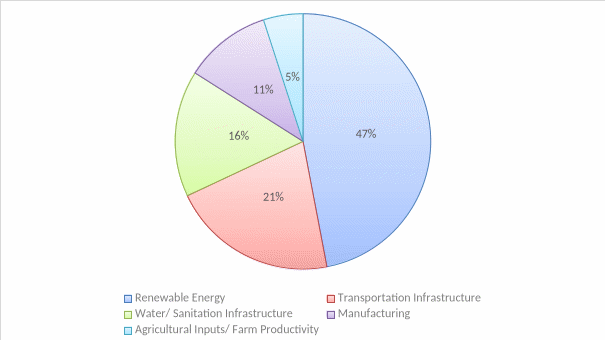
Other de-risking mechanisms commonly used in blended finance include first-loss guarantees (in which a guarantor covers a specified percentage of losses) and cross-currency swaps (which hedge against currency fluctuations). Blended finance is particularly important for sustainability projects with high impact in countries where political and investment risks discourage private investors. In such cases, concessional capital is used to help attract private investment rather than to substitute for it (Flammer et al., 2026). Figure 2 presents the distribution of blended finance deals by sub-sector from 2022 to 2024 (Convergence Blended Finance, 2025). The data reveals that renewable energy accounted for the largest share at 47 per cent, followed by transportation infrastructure (21 per cent) and water/sanitation infrastructure (16 per cent).
Source: Convergence State of Blended Finance 2025
2.3. Performance-based Financing
Performance-based financing is a financing mechanism where funds or payments to service providers are linked to performance or results achieved. Unlike traditional financing, which provides funds upfront, performance-based financing links payments to actual results (World Bank, 2022). For example, payments may depend on the amount of energy saved or emissions reduced. This ensures that funding is tied to measurable outcomes rather than planned activities, serving as an important enabler for small and medium enterprises and allowing them to adopt capital-intensive technologies that were previously inaccessible.
A key feature of performance-based financing is the verification of results. IoT sensors, smart meters, and digital monitoring systems are often used to track energy savings and other outcomes in real time, ensuring that payments are linked to actual performance rather than estimates. By reducing upfront costs and linking payments to actual performance, this approach can help businesses adopt sustainable technologies while lowering financial and operational risks. For instance, in a Kenyan initiative using solar-powered cold storage hubs, farmers using a performance-based payments service increased their incomes by 20–40 per cent while cutting food waste to as low as 2 per cent (Refindustry, 2025). At the same time, verifying measurable outcomes improves transparency and accountability while reducing the risk of greenwashing.
2.4. Asset Tokenisation
Asset tokenisation is the process of converting ownership rights in a financial asset into digital tokens that can be recorded, traded, and tracked using distributed ledger technology (DLT) or blockchain-based platforms. Tokenisation of financial instruments, such as green and sustainability bonds, offers several advantages over traditional mechanisms.
Tokenisation enables fractional ownership, lowering entry barriers and broadening access to investment opportunities by widening the pool of investors. A wider, more diverse investor base can improve market liquidity by enabling more participants to buy and sell tokens, reducing the risk of illiquidity that often affects traditional bond markets (Hong Kong Monetary Authority, 2023). Further, blockchain-based technology can also improve transparency and verification while enabling other stakeholders to track and verify transactions and sustainability outcomes and helping to reduce concerns about greenwashing. For instance, in a study of 15 European green enterprises, blockchain-enabled systems improved carbon reporting accuracy by 25 per cent, delivered 18 per cent savings in wasted energy and showed a 15 per cent reduction in operational costs (Zhang, 2025). To understand how these instruments function, the following section examines four real-world case studies from the Asia-Pacific region, each illustrating how innovative financing mechanisms reduce traditional investment barriers and support capital flows into green technology.
3. Case Studies
3.1. AirTrunk, Asia-Pacific and Japan
The growing demand for artificial intelligence and cloud computing has accelerated the need for data centres (Cruzes, 2026). Data centres are highly resource-intensive, with their share of global electricity demand projected to increase from around 2 per cent currently to 4 per cent by 2030 (Deloitte, 2024). Cooling systems alone can account for up to 40 per cent of a data centre's energy consumption and may require 3-5 million gallons of water per day in large facilities (Johnson, 2025). Amid these growing environmental concerns, AirTrunk, a leading hyperscale data centre operator in the Asia-Pacific and Japan region, provides a notable example of how innovative financial instruments can mobilise finance for sustainable infrastructure.
AirTrunk utilises sustainability-linked loans and bonds to raise capital for its regional expansion. In 2025, it closed an A$16 billion (Australian dollar) sustainability-linked financing deal, becoming one of the largest sustainable finance issuers in the data centre industry. Through these instruments, the company links borrowing costs to key performance indicators focused on energy efficiency, renewable energy adoption, water efficiency, and social impact, embedding sustainability considerations across its digital infrastructure footprint. The company targets industry-leading levels of operational efficiency through metrics such as Power Usage Effectiveness (PUE) and Water Usage Effectiveness (WUE), while increasing the share of renewable energy used to meet its electricity requirements, aligning its commitment with the UN’s Sustainable Development Goals (AirTrunk, 2025).
Unlike traditional debt financing, sustainability-linked instruments can create direct financial incentives for organisations to achieve measurable environmental impact. The case demonstrates how performance-based financing can reduce funding constraints for resource-intensive industries, such as data centres, while encouraging greater accountability for environmental performance.
3.2. Just Energy Transition Partnership (JETP), Indonesia
With electricity generation remaining heavily dependent on coal and energy demand continuing to rise, Indonesia faced the urgent challenge of transitioning to clean energy while ensuring a just transition for workers and communities dependent on the coal industry (Resosudarmo et al., 2023). The early retirement of coal power plants and the scaling of renewable energy infrastructure required massive investments. In 2022, the Indonesian Government entered into a partnership with the International Partners Group (which includes the governments of Canada, the United Kingdom, the United States, Denmark, France, Germany, Italy, Japan, and Norway) and the Asian Development Bank, acting as the lead development partner, to mobilise more than USD 20 billion over the next 3–5 years to support Indonesia’s clean energy transition (Jazuli et al., 2024).
The JETP uses a blended finance model funded jointly by public and private investments. Around USD 10 billion is provided by the International Partners Group, while the remainder is expected to be raised through private investment (PricewaterhouseCoopers, 2024). The blended finance structure helps reduce investment risks and makes clean energy projects more commercially viable. The project also enables the partners to contribute their technical expertise and know-how to support the development of innovative technologies. A key part of the JETP is its blended finance approach, which uses concessional loans, commercial debt, guarantees, and carbon credit revenues to make renewable energy projects more viable. By combining concessional funding with commercial finance, the partnership aims to lower borrowing costs, increase project profitability, and attract additional private investment (Asian Development Bank, 2024). The initiative also includes a just transition framework to support workers and communities affected by the move away from coal. This case study demonstrates how a combination of public and private funding, technical expertise, and institutional coordination can reduce investment risks and mobilise capital for new green technologies.
3.3. Smart Joules, India
As global warming intensifies, demand for cooling energy continues to rise across India, while many businesses face difficulties in investing in energy-efficient technologies due to the significant upfront capital required (Gupta, 2025). Smart Joules provides an interesting solution to this problem through its innovative models. While the company is headquartered in Delhi, it has expanded pan-India, serving prominent hospital chains such as Apollo, Fortis, and Aster, among others (Smart Joules, 2019). The company offers “Cooling as a Service (CaaS)”, in which it owns, operates, and maintains cooling infrastructure for large and MSMEs (Micro, Small and Medium Enterprises) businesses, while the client only pays for the cooling service they consume. This enables client businesses to reduce the upfront costs and transfer the operating risks to the service provider, thereby transforming a large capital expenditure into a manageable operating expense.
The company also provides a “Pay as you Save” service for implementing energy conservation measures and energy-efficiency technology upgrades in existing buildings. The client does not pay the cost of the upgrades; instead, they pay from the energy savings. IoT and AI-enabled tracking of energy savings ensures payments are linked to actual performance.
Smart Joules is using these innovative performance-based models to enable companies to adopt energy-efficient technologies and make a significant impact, particularly in the hospital and healthcare sectors in India (ADB Ventures, 2023). The case highlights how removing the need for large upfront investments and linking payments to actual savings can reduce barriers to the adoption of green technologies while encouraging more efficient energy use.
3.4. Digital Green Bonds, Hong Kong Special Administrative Region (HKSAR) Government
The HKSAR Government in Hong Kong issues digital green bonds, which combine sustainable finance with digital technologies to improve the efficiency, transparency, and accessibility of green bond markets. Unlike conventional bonds, digital green bonds utilise asset tokenisation, whereby bond ownership and transactions are recorded on a digital ledger (Hong Kong Monetary Authority, 2023). Blockchain technology streamlines issuance and settlement processes, reducing administrative costs. The platform also integrates green disclosures with the digital asset, improving transparency in the management and reporting of funds raised for environmental projects.
A key feature of tokenised bonds is fractional ownership. Traditional green bonds often have high minimum investment amounts, making them out of reach for smaller investors. Tokenisation divides a single bond into many smaller digital tokens, each representing a fraction of the underlying asset. This significantly lowers the entry barrier, allowing participation from a wider pool of investors and potentially improving market liquidity for these bonds. The third issuance of these bonds in November 2025 also integrated e-CNY (electronic Chinese Yuan) and e-HKD (electronic Hong Kong Dollar), enabling shorter T+1 settlement cycles and reducing costs and counterparty credit risk (Hong Kong Monetary Authority, 2025).
The case demonstrates how HKSAR's tokenised green bonds combine blockchain with green finance to address persistent barriers in sustainable debt markets by improving access and liquidity, reducing costs and settlement cycles, and enhancing transparency and accountability in the use of proceeds.
4. Challenges, Opportunities and Policy Recommendations
Despite the growing adoption of innovative financing mechanisms, economies face several challenges that continue to limit their ability to mobilise capital at the scale required for the transition to green technology. A major constraint is the shortage of commercially viable green technology projects. Even when capital is available, projects with clear financial returns and measurable environmental impact remain limited, discouraging private capital. This challenge is particularly pronounced in emerging economies, where policy uncertainty, inconsistent regulatory frameworks, and the lack of standardised sustainability taxonomies increase investment risk. Without harmonised taxonomies aligned with global standards, mobilising cross-country private capital remains challenging.
Further, many innovative financing instruments rely on the measurement and verification of sustainability outcomes. However, the digital infrastructure required to support these processes, including IoT and AI-based monitoring systems and blockchain platforms, remains underdeveloped in several developing economies (Ahmad et al., 2025). Regulatory uncertainty and limited institutional capacity may further slow the adoption of these technologies. Addressing these challenges is crucial in improving accountability, reducing greenwashing concerns, and building investor confidence in sustainable finance markets.
Significant opportunities exist, despite these challenges. Advances in digital verification technologies and blockchain platforms are making it easier and more cost-effective to monitor and verify sustainability outcomes. At the same time, efforts to align sustainability taxonomies, such as the European Union Taxonomy and the Association of Southeast Asian Nations (ASEAN) Taxonomy for Sustainable Finance, are helping to reduce fragmentation across jurisdictions. As common standards emerge, cross-border investments are likely to become more efficient and accessible. Multilateral development banks and development finance institutions are also expanding the use of blended finance and risk-sharing mechanisms to attract private capital into green projects, particularly in emerging economies (International Monetary Fund, 2024). In addition, rising carbon prices in both voluntary and compliance markets are creating new revenue opportunities for low-carbon investments.
A particularly significant opportunity stems from the European Union's Carbon Border Adjustment Mechanism (CBAM). CBAM imposes carbon tariffs on imports of high-emission goods, such as steel, aluminium, and fertilisers. For Asia-Pacific economies that rely heavily on exports to European markets, this creates a strong economic case for adopting green technologies. Industries that invest early in low-carbon production will gain a competitive advantage, helping them maintain market access and reduce future costs. This creates a strong incentive for governments and businesses in the region to prioritise green technology financing and accelerate the transition towards more sustainable production systems.
To address these challenges and capitalise on emerging opportunities, policymakers should focus on strengthening digital verification infrastructure, including IoT and AI-based monitoring systems, while creating regulatory frameworks that enable the safe adoption of blockchain-based financing instruments. Further, policymakers should work towards harmonising sustainability taxonomies at the regional and international levels to facilitate cross-border investments. Targeted tax incentives and subsidies can lower upfront costs and improve project viability, particularly for SMEs. In addition, development banks, public finance institutions, and governments should expand blended finance and risk-sharing mechanisms to attract private capital and support the adoption of low-carbon technologies. Together, these measures can improve access to finance, reduce investment risks, and accelerate the green transition across the Asia-Pacific region.
5. Framework for Innovative Financing Mechanisms for Green Technology Adoption
Source: Author
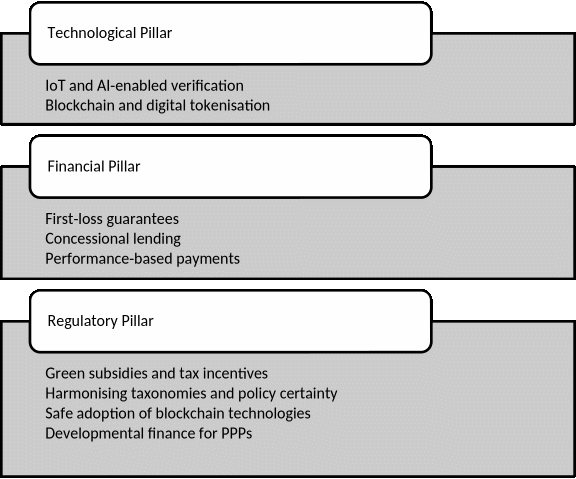
Based on our study, we present a conceptual framework (Figure 3) to understand the key enablers of innovative financing for green technologies. The framework is built around three interconnected pillars: technological, financial, and regulatory. The technological pillar focuses on digital tools such as IoT-enabled monitoring systems, AI-based verification, and blockchain platforms that improve transparency, verification, and accountability of sustainability outcomes. The financial pillar comprises mechanisms such as blended finance, concessional capital, first-loss guarantees, and performance-based financing that help reduce investment risks and improve access to capital. The regulatory pillar includes supportive policies, sustainability taxonomies, disclosure standards, subsidies, and public-private partnerships that create an enabling environment for sustainable investment. Together, these pillars help address key barriers relating to financing, risk, transparency, and verification, thereby supporting the mobilisation of private capital and the adoption of green technologies.
6. Conclusion
Financing remains one of the most significant barriers to the large-scale adoption of green technologies. This article examined how innovative financing mechanisms, such as sustainability-linked instruments, blended finance, performance-based financing, and asset tokenisation, can help overcome these constraints by reducing investment risks, improving access to capital, enhancing transparency, and linking financing to measurable sustainability outcomes. The article draws upon four contemporary case studies from the Asia-Pacific region to demonstrate how innovative financing removes investment barriers and democratises access to green technology investments. The article also provides policy recommendations and presents a conceptual framework, highlighting the key enablers of innovative financing mechanisms for green technology adoption. With appropriate policy support and enabling frameworks, these innovative financing mechanisms can play an important role in mobilising private capital and accelerating the adoption of green technologies across the Asia-Pacific region.
References · 29 citations
How to cite
Mayank Joshipura and Nikita Kedia (2026). “GreenTech Transition and Financial Innovation: Emerging Mechanisms for Sustainable Development.” Asia-Pacific Tech Monitor, Vol. 43, No. 2.
Technology offer
Interested in this technology?
Request further information or explore potential cooperation with the technology provider.
Technology request
Can you help meet this technology need?
Share a relevant technology, expertise or partnership opportunity with APCTT.