
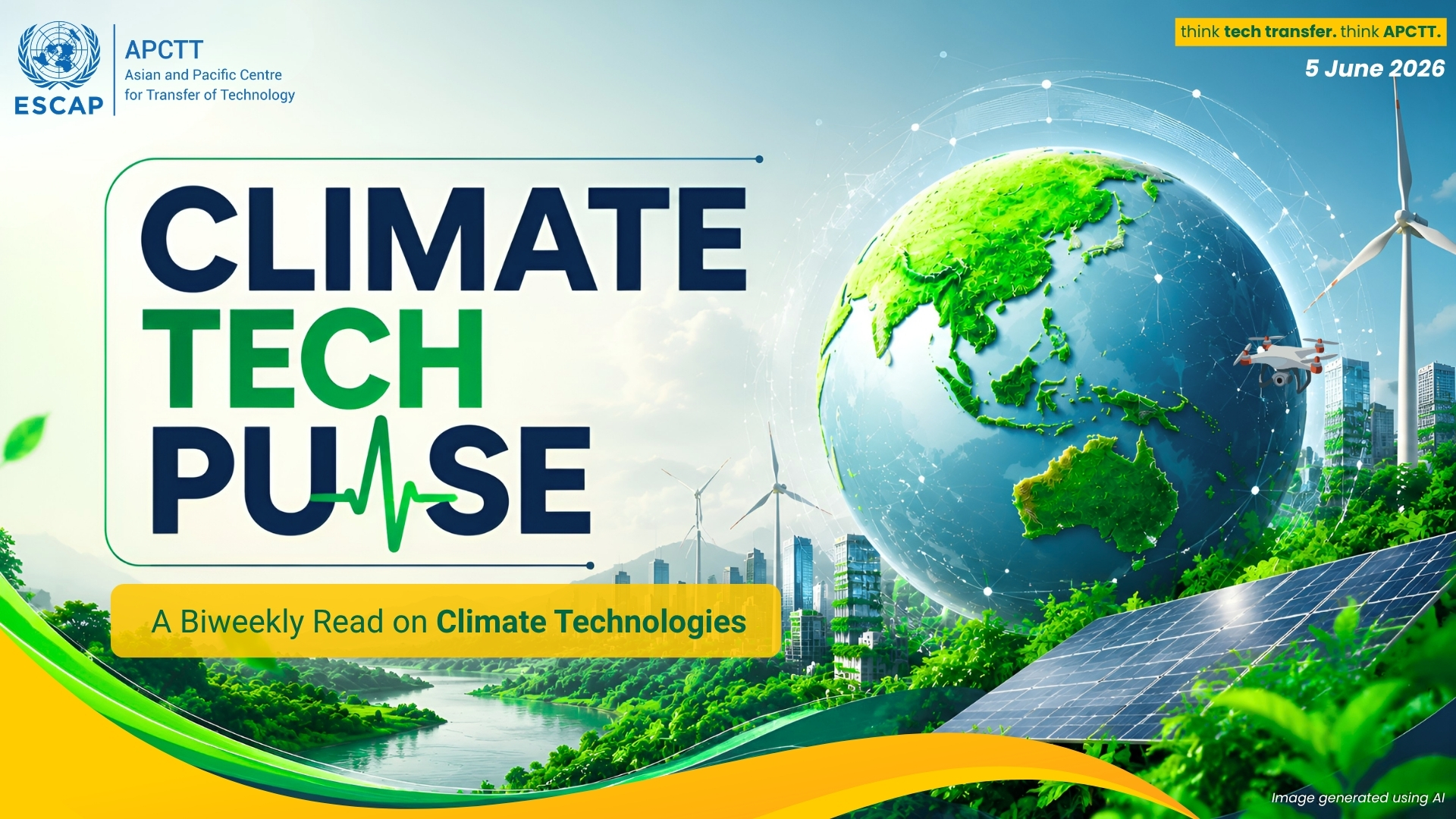

Welcome to the first edition of Climate Tech Pulse — a biweekly briefing from APCTT. Each edition follows the information on climate technologies being developed, adopted and scaled across Asia and the Pacific. It presents a compilation of relevant information from web-based sources.
There is no more fitting day to begin this initiative than the World Environment Day. On this World Environment Day, one signal stands out across Asia and the Pacific: the adoption of renewable energy technology remains an important strategy — not only for the environment, but for energy that is affordable, reliable and locally produced. With global energy prices rising and volatile, and the cost of solar and batteries continuing to fall, clean power is increasingly the practical default rather than the idealistic choice. From households to national plans, here is how that played out in recent weeks.
With the right policies, cheap home batteries have turned solar-plus-storage into a routine way to cut bills — proof the shift is durable.
A new one-megawatt rooftop solar system on the National Parliament signals a steady move toward clean, self-reliant energy.
As panels become a commodity, major makers are scaling battery storage (exports seen rising ~30% to 150 GWh in 2026) — the piece that makes solar dependable around the clock.
Now the world's third-largest holder of installed renewables (non-fossil past 50%), with firms increasingly choosing clean power for hard commercial reasons.
A certified world-record 25.14% perovskite tandem cell points to next-generation solar that can be both made and used at home.
Its first full-cycle green-hydrogen pilot, with locally developed storage, shows adoption is also about building domestic capability.
The new national budget puts energy at the heart of economic strategy, adding 1,040 MW next year and steering cheap power toward higher-value industries.
A market-driven solar boom, powered by high power costs and cheap panels, could save the country around US$6.3 billion in fuel imports in 2026.
Rooftop-solar installations have surged (the Philippines ~170%; Thailand's installer-training demand tripled) — the constraint now is supply chains and skilled installers, not demand.
Existing wind and solar should save roughly US$4.7 billion in fuel imports this year, as Seoul prepares to nearly triple capacity toward a 100 GW target.
Approval of its first offshore wind project expands renewable supply as the country works toward ambitious 2030 targets.
Disclaimer: Climate Tech Pulse compiles publicly available web-based news and information on climate technologies across Asia and the Pacific. Linked content reflects the views of its original authors or publishers and does not necessarily represent the views or positions of APCTT or UN ESCAP.
Technology offer
Interested in this technology?
Request further information or explore potential cooperation with the technology provider.
Technology request
Can you help meet this technology need?
Share a relevant technology, expertise or partnership opportunity with APCTT.