

Artificial Intelligence as an Enabler of Youth Entrepreneurship: Strategy and Practical Insights from Singapore

Artificial intelligence (AI) is increasingly shaping youth entrepreneurship by lowering entry barriers, enhancing data-driven decision-making, and accelerating innovation. For young founders, AI tools support key stages of the design-thinking process, ideation, market analysis, and business-model development. This paper examines how AI adoption can support youth entrepreneurship in Singapore in diverse start-up contexts. Adopting a practice-oriented lens, the study illustrates how AI, data analytics and intelligent automation enable young entrepreneurs to develop viable business models and sustainability-oriented solutions. Singapore provides a compelling context due to its advanced digital infrastructure and strong institutional support. The findings highlight how its ecosystem — including strategic direction, digital infrastructure, capability development, financial and resource support, and responsible AI governance — shapes entrepreneurial capabilities and outcomes. The article concludes with policy implications for technology agencies, enterprises, entrepreneurship educators and policymakers in ASEAN economies, emphasizing inclusive AI capability-building, ecosystem coordination and responsible innovation to strengthen youth-entrepreneurship development.
1. Introduction
Artificial intelligence (AI) is considered a transformative technology that is changing entrepreneurial processes (Organisation for Economic Co-operation and Development (OECD), 2025). According to Mayer and others (2025), “92 per cent of companies plan to increase their AI investment” over the next three years, and 92 per cent of businesses in Singapore have adopted AI (PR Newswire, 2025). AI is increasingly deployed to shape the entrepreneurship landscape, especially for young founders, by reducing entry barriers, improving data-driven decision-making, facilitating networking, and accelerating innovation. AI tools support the key stages of the design-thinking process, including identifying problems, generating ideas, scanning and analysing the market, and selecting suitable business models.
This paper examines how AI enables youth-led enterprises in Singapore and how ecosystem conditions shape their success. It also outlines key policy implications for policymakers, technology agencies and relevant stakeholders. The paper concludes with recommendations to strengthen inclusive AI capability-building, enhance ecosystem coordination and promote responsible use of AI and responsible innovation frameworks. Such measures are essential to ensure that AI-driven youth entrepreneurship contributes meaningfully to sustainable development.
Singapore is selected for its advanced digital infrastructure, pro-innovation policies and strong AI regulatory frameworks. Institutionally, Singapore has well-established institutions that govern AI development and facilitate its adoption by businesses and start-ups. Key institutions, such as the Infocomm Media Development Authority and AI Singapore, have positioned the country as a regional AI hub. Enterprise Singapore provides targeted support for start-ups, while higher education institutes have launched initiatives to nurture future entrepreneurs. Research coordination through the National Research Foundation (NRF) further strengthens the innovation ecosystem. In the 2026 budget, the Singapore Government announced a 154.7 billion United States dollar investment in AI and expanded national support to help enterprises and individuals adopt AI technologies (Chelvan and Teo, 2026; Tham, 2026). A National AI Council, announced during Singapore Budget 2026 on 12 February 2026, will also be established to advance the country’s AI agenda (Chelvan and Teo, 2026). Overall, the Singapore case offers a valuable example of digital adoption that underpins AI-driven and youth-led entrepreneurship.
2. Artificial intelligence and youth entrepreneurship
2.1 Functional capabilities of AI in entrepreneurship
AI has been recognized for its foundational, enabling-technology character that can improve entrepreneurial capability across various stages of the business-venture lifecycle. For young founders, AI adoption reduces entry barriers, enhances data collection and analytical capacity, and facilitates sustainability-oriented innovative product, service and process development. AI can serve as a capability amplifier, supporting problem identification, idea generation, experimentation, and impact monitoring and measurement (OECD, 2023a; United Nations Conference on Trade and Development (UNCTAD), 2021a).
2.1.1 AI for ideation, opportunity recognition and market validation
Entrepreneurship often starts with opportunity recognition. Traditionally, this process requires industry experience, professional networks, resource availability and market intelligence. However, resources and networks are often limited for young founders. In the digital era, AI-enabled tools help address these constraints by rapidly collecting business intelligence, analysing market size and trends, processing large datasets and producing business concepts. Speed is important, as business opportunities are often time-sensitive.
Large language models and AI applications enable young entrepreneurs to identify customer pain points and needs, and underserved customer segments or markets, analyse competitor landscapes, create business-model alternatives, prepare a business plan including financial projections and pitch materials, validate their proposed business models or prototypes, and find funding opportunities (Tian and others, 2026).
AI adoption also reduces the costs of testing, monitoring and commercializing new products and services, which can accelerate early-stage iteration. OECD (2025) explains that AI enhances innovation cycles, productivity and decision-making capabilities. UNCTAD (2021b) further highlights that AI-driven analytics enables firms to decode market signals and respond quickly to consumer demands. Advanced analytics and predictive modelling also assist start-ups in conducting sentiment and market analysis, forecasting demand patterns and anticipating market volatility more accurately. This strengthens evidence-based and data-driven entrepreneurship, which is valuable for newcomers in reducing uncertainty.
2.1.2 AI-enabled automation and productivity
AI-enabled tools can also improve enterprises’ operational efficiency and scalability. Automation systems can simplify administrative and operational processes, engage customers and support logistics management. Traditionally, labour and overhead costs spent on these functions are substantial; in addition, lengthy periods of time may be needed to complete the tasks.
Young entrepreneurs and start-up founders can leverage AI-enabled applications to improve productivity and streamline business processes, which can lead to lower prices. These include AI-powered chatbots for pre- and post-sales customer service, AI-driven accounting and financial-tracking systems that can help to detect fraud at an early stage, AI-based marketing-automation tools that can personalize marketing messages to customers, and AI solutions for supply-chain optimization (McKinsey & Company, 2025).
Empirical evidence shows that firms implementing AI technologies have experienced improved productivity and operational efficiency. By automating routine and time-consuming tasks, AI enables entrepreneurs to focus on strategic activities, conceptual thinking, product and service innovation, and partnership development (OECD, 2023a). Young founders usually operate with limited workforce and resources; these productivity gains are particularly important for their long-term business sustainability. AI makes it possible for small start-ups to compete in digitally intensive markets, reducing structural disadvantages relative to established firms. This aligns with the observation by Miah and others (2025) that digital-entrepreneurship ecosystems flourish when small enterprises can have access to scalable digital infrastructure.
2.1.3 AI for social and sustainability-oriented entrepreneurship
AI should not be considered solely a commercial enabler; it also facilitates purpose-driven social entrepreneurship. Youth-led ventures can integrate sustainability (social, economic and environmental) and social-impact value propositions into their business models. In Singapore, about 40 per cent of social enterprises are led by young people aged 35 years and below (Soristic, n.d.). For example, Seastainable, a social enterprise in Singapore providing environmental consultancy started by a young entrepreneur, redirects 50 per cent of its profits to support marine conservation in the South-East Asian region; and Commenhers is “a youth-run clothing brand that upcycles denim to create re-fashioned denim clothes and accessories” (Dharshini, 2023, para. 7).
AI systems support social-impact initiatives by enabling data-driven sustainability measurement and optimization. Applications include tools to optimize energy and water consumption, carbon-footprint estimation systems, analytics platforms to monitor waste generation and recycling performance, and AI-enabled solutions that improve vulnerable populations’ access to essential services. AI also enhances transparency and accountability in social enterprises by improving impact tracking, data reporting and performance monitoring.
Such innovations align with the Sustainable Development Goals (SDGs), which are prioritized across Association of Southeast Asian Nations (ASEAN) member States. UNCTAD (2021a) notes that advanced technologies, including AI, have accelerated progress toward the SDGs when adoption is inclusive and supported by responsible governance.
However, challenges of AI adoption remain. For instance, unequal access to AI infrastructure, unaffordable AI tools and systems, and persistent digital-literacy gaps may widen inequalities among entrepreneurs. Thus, responsible governance frameworks — focusing on algorithm-agnostic, technology-agnostic, sector-agnostic, and scale- and business-model-agnostic elements — are essential to ensure fairness, transparency and trust in AI-enabled ventures (Infocomm Media Development Authority, 2026).
2.2 Structural conditions for AI-enabled entrepreneurship
Practically, structural conditions also influence the impact of AI on youth entrepreneurship. These conditions may include digital-infrastructure availability, affordable and easy access to the Internet and cloud computing, financial systems and education systems that jointly reduce entry barriers and enhance scalability (OECD, 2023a; World Bank, 2022). Entrepreneurial innovative ecosystems, involving many stakeholders, shape the landscape within which youth-led ventures emerge. The concentration and coordination of these actors affect opportunity identification and capture, resource mobilization and allocation, and market access for young entrepreneurs.
2.3 Normative foundations of responsible AI adoption
Besides functional capabilities and structural conditions, youth-led entrepreneurship also requires normative foundations that can ensure legality and build trust. Ethical AI principles, data-protection standards and guidelines, cybersecurity principles and regulatory approaches help address concerns related to privacy, security, transparency and data bias (United Nations Educational, Scientific and Cultural Organization (UNESCO), 2022; OECD, 2019). Such AI-related governance mechanisms contribute to mitigating reputational uncertainty and regulatory costs while reinforcing stakeholder confidence. Therefore, responsible adoption of AI strengthens legitimacy and supports sustainable and socially responsible entrepreneurial growth.
3. Singapore’s AI-enabled youth-entrepreneurship ecosystem
Building on the conceptual framework discussed in the previous section, the Singapore case illustrates how institutional, infrastructural and governance arrangements operationalize AI-led youth entrepreneurship in practice. Singapore’s experience illustrates that access to technology, and a coordinated national ecosystem — together with digital readiness, strong institutional support, skills development, infrastructure, finance and responsible governance — influences AI adoption among young entrepreneurs (Cockburn and others, 2018; Nambisan and others, 2019; Obschonka and Audretsch, 2020). Instead of operating in silos, these factors reinforce and supplement one another, creating a conducive environment for AI-enabled entrepreneurship. Recent studies show that AI-driven entrepreneurship can develop when it is embedded within an ecosystem that aligns policies, strategies, skills development, leadership and governance (Khanal and others, 2024; Kim and Jin, 2024).
3.1 AI strategic direction and institutional support
AI adoption can reduce experimentation costs and enlarge the range of viable venture possibilities for entrepreneurs. However, institutional coordination affects its transformative potential. Lee and others (2024), Nzembayie and Urbano (2025) and Stefan and others (2025) further argue that new ventures can grow more rapidly, and technologies are diffused faster, when AI strategy is well connected to start-up support systems.
Singapore has established a national AI agenda supported by the NRF and implemented through AI Singapore. AI Singapore is tasked with bringing “together all Singapore-based research institutions and the vibrant ecosystem of AI start-ups and companies developing AI products to perform use-inspired research, grow knowledge, create tools, and develop the talent to power Singapore’s AI efforts” (AI Singapore, n.d.).
This strategy has been further strengthened by the Government’s long-term commitment to invest more in AI. Thus, Singapore illustrates a coordinated approach that integrates AI policy and research, entrepreneurial incentives, start-up support and digital governance.
3.2 Digital infrastructure for AI deployment
Digital infrastructure plays a key role in entrepreneurial activities because AI tools require reliable, high-speed Internet connectivity and well-developed digital systems. Countries and locations with good broadband connections and digital interoperability witness a higher rate of start-up formation and innovation outputs (World Bank, 2021).
Singapore’s Smart Nation initiative, a national strategy launched in 2014, leverages digital technologies and data to enhance governance, economic growth and citizens’ quality of life, with a strong emphasis on digital inclusion and innovation (Smart Nation Singapore, 2025). This initiative exemplifies the transformation by enabling robust high-speed broadband connectivity, interoperable digital systems and secure data-governance frameworks. Such reliable infrastructure reduces operational and transaction costs and expedites AI deployment across sectors. This also enables youth-led start-ups to adopt AI systems without heavy upfront capital investment. Access to reliable and scalable digital infrastructure allows young founders to focus on opportunity exploration and business development instead of technical constraints. In this sense, infrastructure not only supports entrepreneurship but also makes innovation more achievable (Goldfarb and Tucker, 2017).
3.3 AI capability development
Human capital is also a predictor of AI-enabled entrepreneurship. Young founders with AI literacy and digital capabilities are likely to achieve stronger performance and survival outcomes (Bharadwaj and others, 2013; Colombo and Grilli, 2005). A key differentiating factor of knowledge-intensive ventures is their ability to apply AI-generated insights strategically, instead of merely accessing AI tools (Obschonka and Audretsch, 2020).
In this context, higher education institutes in Singapore play a critical role in developing such competencies for young entrepreneurs. They have promoted responsible use of AI in entrepreneurship education, which allows learners to apply AI in opportunity identification, market validation and business-model development (Dwivedi and others, 2023; Nabi and others, 2017; Ng and others, 2021). For instance, through the geron-preneurship course at the Singapore University of Social Sciences (SUSS), AI topics are incorporated to prepare learners to design technology-enabled solutions for seniors with both technical skills and ethical awareness.
Academic training at higher education institutes is complemented by incubators, mentorship, industry linkages and opportunities for learners to test their ideas in the market. Strong networks and ecosystem support assist young founders of start-ups and improve their chances of success (Stam and van de Ven, 2021). A good example is the Agri-preneur Incubation Programme offered by SUSS, where students can gain hands-on urban-farming experience and develop sustainable agritech ventures through practical training and pitching opportunities (Begum, 2024). Bharadwaj and others (2013) and Tambe (2014) also explain that enterprises possessing internal AI capabilities tend to achieve higher productivity than those relying only on outsourced expertise. Higher education institutes and incubators can jointly transform AI from a basic tool into a strategic entrepreneurial capability, enhancing youth-venture resilience.
3.4 Resources and financial support
Access to finance and other resources plays a significant role in an enterprise’s survival and growth, and start-up viability. AI adoption increases firms’ productivity, but sustained growth depends much on financial resources and ecosystems (Chen and others, 2025). Apparently, productivity gains do not automatically translate into long-term growth without complementary funding mechanisms.
Singapore addresses this through several financial mechanisms, such as grants, co-investment schemes and mentorship-linked funding (Ministry of Digital Development and Information, 2026). The alignment of funding, skills development and market access reduces fragmentation and access inequalities, and enhances ecosystem efficiency. Public-private collaboration further accelerates experimentation and commercialization. For example, the AI Trailblazers initiative, a collaboration between Singapore’s Ministry of Communications and Information, Digital Industry Singapore, Smart Nation and Digital Government Office, and Google Cloud, enables firms and government agencies to adopt AI to address real-world challenges. This initiative has enabled about 100 organizations in Singapore to access Google Cloud’s high-performance graphical-processing units in a streamlined and efficient manner (Economic Development Board, 2023). Another initiative is the Digital Enterprise Blueprint, which brings together government, industry and educational institutions to support small and medium-sized enterprises (SMEs) and workers with expertise, resources and digital technologies. Initially, eleven partners — including Amazon Web Services, Google, Microsoft, Alibaba Cloud, DBS Bank Ltd, Prudential, Salesforce, ST Engineering, Singapore Business Federation, Singapore Computer Society and SGTech — committed to support SMEs through initiatives promoting AI adoption, cloud solutions, cybersecurity and workforce upskilling, thereby enabling firms to enhance productivity, scale operations and strengthen digital resilience (Ministry of Digital Development and Information, 2025). Close coordination among government agencies, universities and enterprises strengthens the financial and institutional support structure for start-ups.
This integrated approach reflects entrepreneurial-ecosystem theory, which emphasizes the importance of multi-sector coordination among government, higher education institutions, industry and other stakeholders to support long-term venture success (Stam and van de Ven, 2021). For young entrepreneurs adopting AI, a well-connected ecosystem reduces avoidable risks and improves their adaptability for growth.
3.5 Responsible AI governance
In the digital era, AI-driven enterprises and start-ups operate in data-intensive and ethically sensitive conditions. Thus, trust, transparency and accountability greatly influence stakeholders’ acceptance and investors’ decisions. Firms with transparent AI governance more easily attract external financing and gain stakeholders’ trust (Dwivedi and others, 2023; OECD, 2019; World Economic Forum, 2022).
The Infocomm Media Development Authority introduced Singapore’s Model AI Governance Framework in 2020 and launched a new Model AI Governance Framework for Agentic AI in January 2026. It is a “first-of-its-kind framework”, which aims to help organizations deploy AI systems responsibly by clearly depicting risk-management practices, technical and non-technical control mechanisms, and focusing on meaningful human accountability and oversight when using AI systems (Infocomm Media Development Authority, 2026).
These AI-governance frameworks are reinforced by the Personal Data Protection Act 2012 and grounded in principles of fairness, explainability and accountability. By setting clear standards for responsible AI deployment, they enable young entrepreneurs to build trust with stakeholders, proactively mitigate risks, and strengthen their legitimacy through recognized ethical-governance practices. Therefore, responsible governance acts as a strategic asset, instead of a constraint (Papagiannidis and others, 2025). It differentiates AI ecosystems on the basis of reliability, credibility and legitimacy that are valued by stakeholders in the entrepreneurial journey.
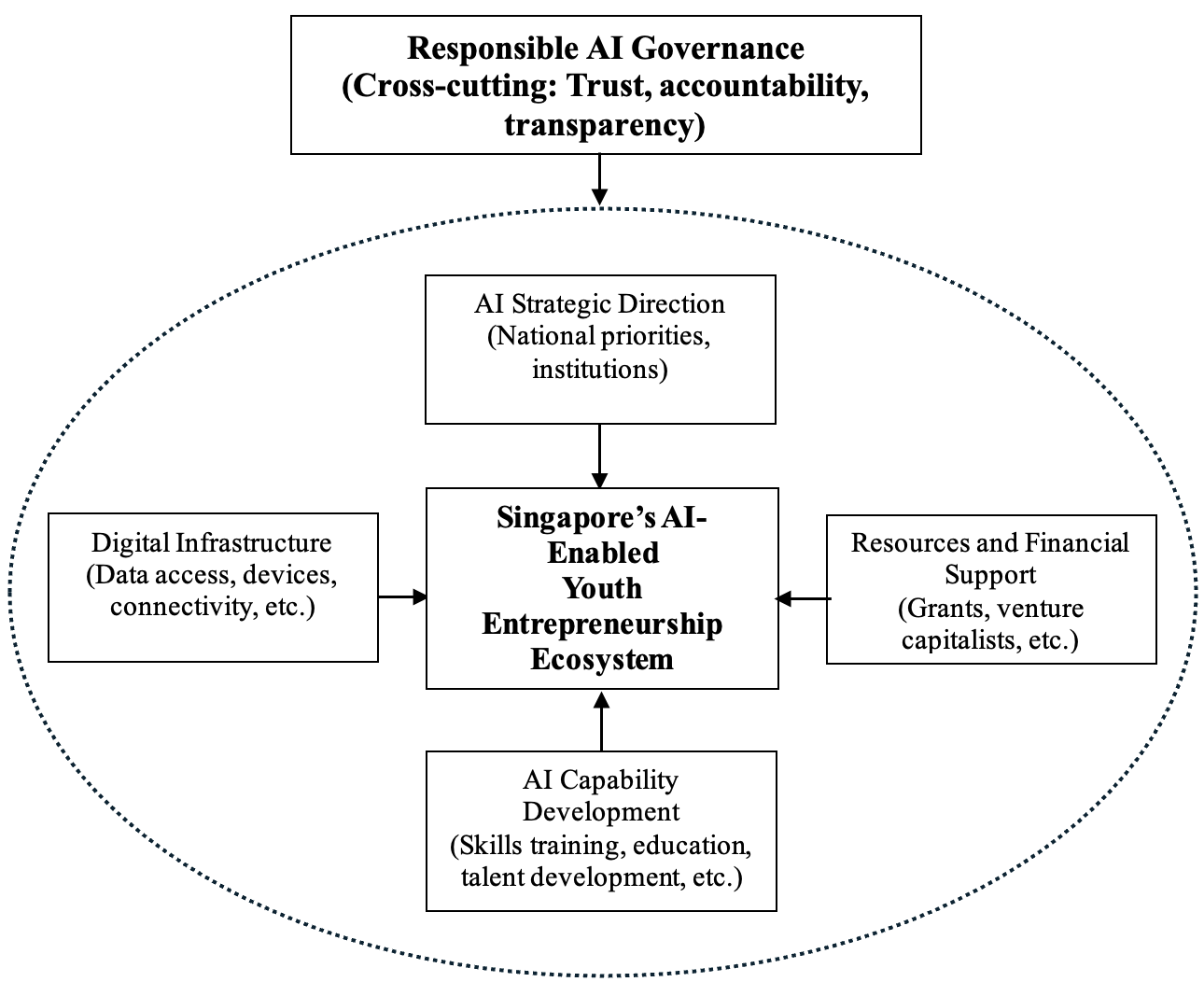
Overall, responsible AI governance operates as a cross-cutting foundation shaping strategic direction, infrastructure deployment, capability development and financial-support mechanisms, as depicted in figure 1.
3.6 Case study: the Alibaba Cloud–SUSS Entrepreneurship Programme
A good example of higher education-industry collaboration in advancing AI-enabled youth entrepreneurship is the Alibaba Cloud–SUSS Entrepreneurship Programme, jointly launched by SUSS and Alibaba Cloud (Alibaba Cloud, 2017). Participants in this programme receive structured entrepreneurship training supported by industry-grade AI tools provided by Alibaba Cloud. The curriculum integrates technology and business innovation, including the development of AI-driven solutions, and they are granted complimentary access to Alibaba Cloud services. Beyond infrastructure, the programme strengthens participants’ AI literacy and entrepreneurial competence through experiential learning, mentorship and pitching opportunities. Participants are trained not only to use AI tools but to apply them strategically to identify business opportunities and design business solutions, including solutions that create social impact (SUSS, 2021).
One participant developed Cloud Intern, a start-up that designs AI-powered chatbots to automate customer communication and response management for small businesses (SUSS, 2021). Using AI tools and predictive automation, the chatbots can handle customer enquiries, forecast demand and schedule services with clients. This demonstrates how participants in the programme have leveraged AI to create practical business solutions.
This case illustrates how structured support from universities and industry, blending entrepreneurship education, access to AI technologies, financial resources and real-world business exposure, can enable participants to go beyond theoretical learning and develop AI-enabled start-up ventures (SUSS, 2021). Access to cloud infrastructure and enterprise-level AI tools significantly reduces technical and financial barriers during the prototyping stage, allowing participants to focus on refining business models and market validation.
The programme reflects a strategic direction of linking higher education, industry partnerships and digital innovation to accelerate AI capability development. It also illustrates how AI-enabled youth entrepreneurship emerges from coordinated ecosystem support rather than isolated training. This capability-building function is critical, as sustainable AI entrepreneurship depends on informed and responsible use rather than passive technological adoption (Alshibani and others, 2025). Resource availability, financial support and industry exposure further reduce early-stage vulnerability. At the same time, operating within Singapore’s responsible AI and data-governance framework ensures that AI-driven ventures remain transparent, secure and compliant.
Overall, these interconnected elements — strategic partnership, digital infrastructure, capability development, resource access and governance — show how higher education institutions can serve as catalysts for scalable innovation and responsible AI-enabled youth entrepreneurship (UNESCO, 2025; Vecchiarini and Somia, 2023).
4. Key enablers and challenges
AI-enabled youth entrepreneurship can only thrive if foundational enablers are robust, as AI strengthens individual capabilities through interconnected mechanisms, including skills enhancement, improved access to capital, and reduced risk exposure (Ganuthula, 2025). The key enablers of AI-enabled youth entrepreneurship are:
- Affordable and accessible AI tools and analytics platforms that reduce digital divides, lower entry barriers, improve operational efficiency and advance digital inclusion for emerging ventures (OECD, 2023b; UNCTAD, 2021a).
- Capability and capacity building in AI literacy and digital skills that improves venture performance (Ng and others, 2021; Obschonka and Audretsch, 2020). Sustained capability development through education, mentorship and internships is therefore important (OECD, 2024; World Economic Forum, 2023).
- Strategic public policies, start-up financing mechanisms and collaborative partnerships among education providers, industry and government that further enhance ecosystem cohesion and effectiveness, foster knowledge transfer and strengthen resource mobilization, leading to better venture outcomes (World Economic Forum, 2024).
- Clear AI guidelines and strong data-protection frameworks that build trust, reduce regulatory uncertainty and support responsible innovation. When aligned, these enablers position young entrepreneurs not simply as technology adopters but as competent and sustainable drivers of AI-driven growth.
Although AI-enabled youth entrepreneurship can benefit from robust digital infrastructure, policy support and clear AI guidelines, key challenges remain:
- Young entrepreneurs and founders often encounter gaps between using basic AI tools and the in-depth technical and strategic competencies required to develop competitive ventures. They also have limited access to high-quality data, which can affect scalability beyond pilot projects (OECD, 2023a, 2023b; World Bank, 2021).
- Compliance with data-protection and AI-governance requirements, which are necessary for building trust, may complicate operations and increase operational and regulatory costs for early-stage ventures. Ethical concerns, such as data bias and data-privacy risks, may affect stakeholder trust if they are not well managed (Dwivedi and others, 2023; Stefan and others, 2025).
- Rapid technological advancement and global competition require continuous learning, skills upgrading and adaptation to ongoing changes in the external environment in order to sustain and grow the business.
Overall, AI adoption can improve entrepreneurial productivity but also entails many challenges (Brynjolfsson and others, 2024; Raisch and Krakowski, 2021). Hence, responsible ecosystem design is critical to ensure inclusive and sustainable AI-driven entrepreneurship (Stam, 2015; Autio and others, 2018).
5. Policy implications for ASEAN economies
From the analysis of emerging opportunities, key enablers and challenges, the following are recommended.
Integrated digital-infrastructure development
The public and private sectors, including technology providers and research centres, should invest more in AI-ready digital infrastructure and provide equitable access to AI tools, platforms, high-quality datasets and integrated digital platforms, in order to minimize structural entry constraints and address operational bottlenecks and growth limitations (OECD, 2023a, 2023b; Stefan and others, 2025).
Advanced AI capability and entrepreneurial-skills development
Education providers, industry partners and public agencies should expand advanced AI-skills development, beyond basic tool usage or AI-literacy awareness, by incorporating machine-learning engineering, data governance and responsible AI topics in entrepreneurship curricula in order to narrow capability gaps and improve venture scalability (OECD, 2023a; World Economic Forum, 2023).
Enhancing ecosystem cohesion through strategic partnerships
Multi-sector stakeholders — for example, public authorities, education providers, venture capitalists, industry and technology providers — should formalize educator-industry-investor collaboration platforms to enhance ecosystem cohesion, ensure efficient allocation of resources, strengthen technology-transfer pathways, and enhance start-up survival (Stam and van de Ven, 2021).
Inclusive resource and market access
Key players in relevant sectors should provide financial support, expand targeted financing schemes, cloud credits, mentorship networks and access to national and regional markets. This aims to ensure that young entrepreneurs, especially those without sufficient capital or strong networks, can participate effectively in the digital economy (OECD, 2023b; UNCTAD, 2021a, 2021b).
Operational and trustworthy AI governance
Players in the entrepreneurial ecosystem should develop and implement clear and innovation-friendly AI governance and data-protection frameworks to manage risks, reduce regulatory ambiguity and facilitate responsible scaling of youth-led ventures (OECD, 2019). These are essential to enhance credibility and promote responsible entrepreneurship.
Overall, a multidimensional approach with a well-developed and coordinated ecosystem, integrating skills, infrastructure and governance, is fundamental to harnessing AI for inclusive youth entrepreneurship.
6. Conclusion
AI has emerged as a structural enabler of youth entrepreneurship. AI enables young entrepreneurs to compete in rapidly digitalizing markets by lowering entry barriers, reducing data and testing costs, expanding access to analytics, and accelerating product development and market entry. However, relying only on technology does not guarantee sustainable outcomes. The Singapore experience demonstrates that responsible AI capability-building and collaboration among sectors are equally important. Stakeholders should work closely with one another to ensure that AI adoption fosters entrepreneurial resilience instead of deepening inequality and intensifying risk exposure.
For the region, the key lesson is clear. AI-driven youth entrepreneurship depends not only on AI tools but also on inclusive digital skills, entrepreneurship education, strong partnerships and sound governance. AI can become a catalyst for innovative and sustainable youth-led entrepreneurship only if technological capability development is supported by a coherent and responsible ecosystem.
Technology offer
Interested in this technology?
Request further information or explore potential cooperation with the technology provider.
Technology request
Can you help meet this technology need?
Share a relevant technology, expertise or partnership opportunity with APCTT.