

Youth-Driven Digital Innovation as Infrastructure for Sustainable Development

Youth-led digital innovation is emerging as an important enabler of sustainable development in the Asia-Pacific region, which is home to a significant share of the world’s youth population. As young people increasingly harness digital technologies, such as artificial intelligence, data platforms and other advanced digital tools, their innovations are being recognized as a form of development infrastructure. This article examines how youth-driven digital solutions are contributing to climate action, clean energy access and resource efficiency across diverse sectoral contexts. It analyses the policy, institutional and technology-transfer mechanisms that shape the ability of these innovations to scale, and presents selected case studies demonstrating tangible outcomes in areas such as climate resilience, environmental governance and service delivery. The article identifies key barriers, including regulatory complexity, financing gaps, infrastructure disparities and gender divides, and highlights policy-relevant insights to strengthen youth innovation ecosystems and support inclusive and sustainable digital transformation.
1. Introduction
Sustainable development in the twenty-first century increasingly depends on digital infrastructure and innovation. Beyond traditional physical infrastructure, digital technologies, from artificial intelligence (AI) and big-data platforms to Internet of Things (IoT) networks and digital-twin simulations, now provide critical building blocks for progress on the Sustainable Development Goals (SDGs) (World Bank, 2025; ESCAP, 2024). In the Asia-Pacific region, young people are at the forefront of this digital transformation. The region’s youthful demographic — with approximately 60 per cent of the world’s young people — represents a vast reservoir of technological talent and innovative potential (UNFPA, 2024). Young innovators are not merely passive beneficiaries of new technology; they are active leaders developing and deploying digital solutions to strengthen climate resilience, energy access and resource efficiency (ESCAP, 2024; UNDP, 2024).
Crucially, these youth-driven digital innovations can serve as enabling infrastructure for sustainable development, analogous to the way roads or power grids enable economic activity. They provide platforms and tools that improve the delivery of services, optimize resource use and connect communities in new ways. Examples across the region include AI-driven tools for climate-smart agriculture and disaster response, as well as digital-twin models for optimizing grid reliability and renewable integration (IEA, 2017; UNCTAD, 2025). Youth-led firms are pioneering decentralized climate analytics, hyper-local risk platforms and open-source tools to bridge service-delivery gaps (ESCAP, 2024). These efforts illustrate how the creativity and digital acumen of young people are being channelled into a new layer of development infrastructure: open, adaptive and driven by innovation.
Realizing the full potential of youth-driven digital innovation requires supportive ecosystems. Policy frameworks, institutional capacities and technology-transfer mechanisms must evolve to include and empower young innovators (UN DESA, 2025; UNESCO, 2024). This article examines the enabling conditions that allow youth-led innovation to evolve into infrastructure. Section 2 outlines a conceptual framework; section 3 discusses institutional and policy mechanisms; section 4 presents three case studies; section 5 identifies barriers to scale; and section 6 offers actionable policy recommendations.
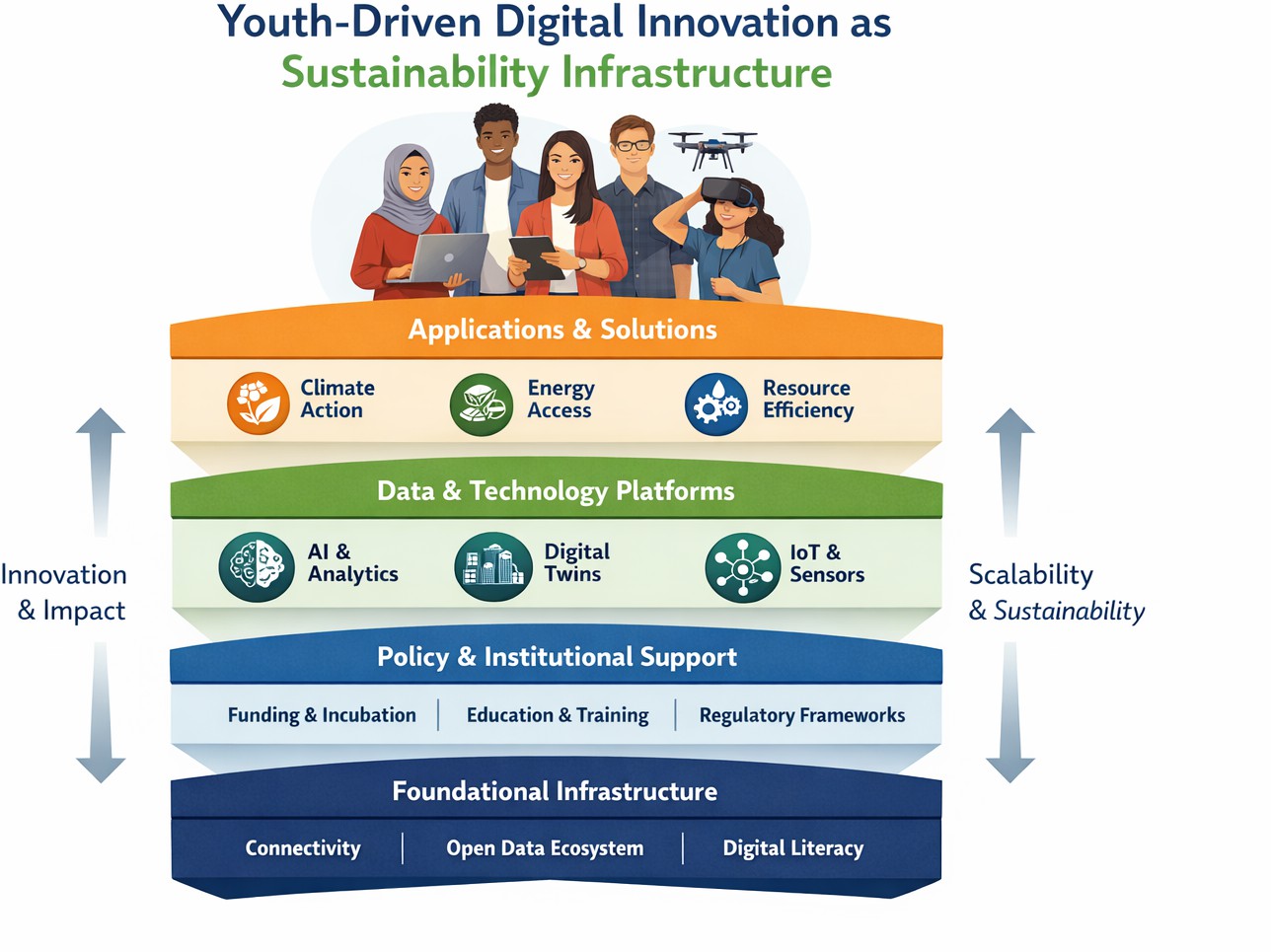
To synthesize the core argument of this article, figure 1 presents a conceptual framework that positions youth-driven digital innovation as a layered form of sustainability infrastructure. The framework organizes the discussion across foundational enablers, core digital building blocks, youth-led solution layers, institutional embedding mechanisms and sustainable development outcomes. Each layer corresponds to specific analytical sections of this paper, creating a structural map that links conceptual framing to empirical examples, policy analysis and recommendations.
2. Youth-led digital innovation as enabling infrastructure
Youth-led digital innovations are increasingly understood not as isolated tools, but as enabling infrastructure and interoperable systems that deliver essential services for sustainable development. This perspective stems from the role such innovations play in areas ranging from climate data and energy management to health care and education. In many Asia-Pacific contexts, young people have helped fill gaps left by inadequate traditional infrastructure by building platforms that bridge service gaps in energy, health, agriculture and climate adaptation, and that connect citizens to actionable data and support networks.
For instance, youth innovators have developed mobile applications for real-time alerts, open-data tools for hazard mapping and coordination platforms for relief logistics, forming digital lifelines in regions underserved by physical infrastructure (UN DESA, 2025; ESCAP, 2024). By rapidly adopting new technologies, Asia-Pacific youth bring fresh perspectives to persistent development challenges, often devising solutions that are more agile, affordable and user-centric (ESCAP, 2024).
One salient example is the use of digital-twin technology in energy and urban systems. Digital twins, dynamic data-driven replicas of physical systems, enable predictive simulation, optimization and real-time decision support. In the hands of young technology entrepreneurs and researchers, digital twins are being applied to model renewable-energy grids, water networks and even cities for sustainability planning. The broader trend of digitalization in the energy sector (encompassing sensors, connectivity, data platforms and analytics) has been identified as a pathway to improved system efficiency and flexibility (IEA, 2017). These developments underscore that youth-driven digital innovation, whether an AI algorithm for energy optimization or a data platform for climate resilience, often functions as critical infrastructure by improving decision-making, efficiency and the reach of development interventions.
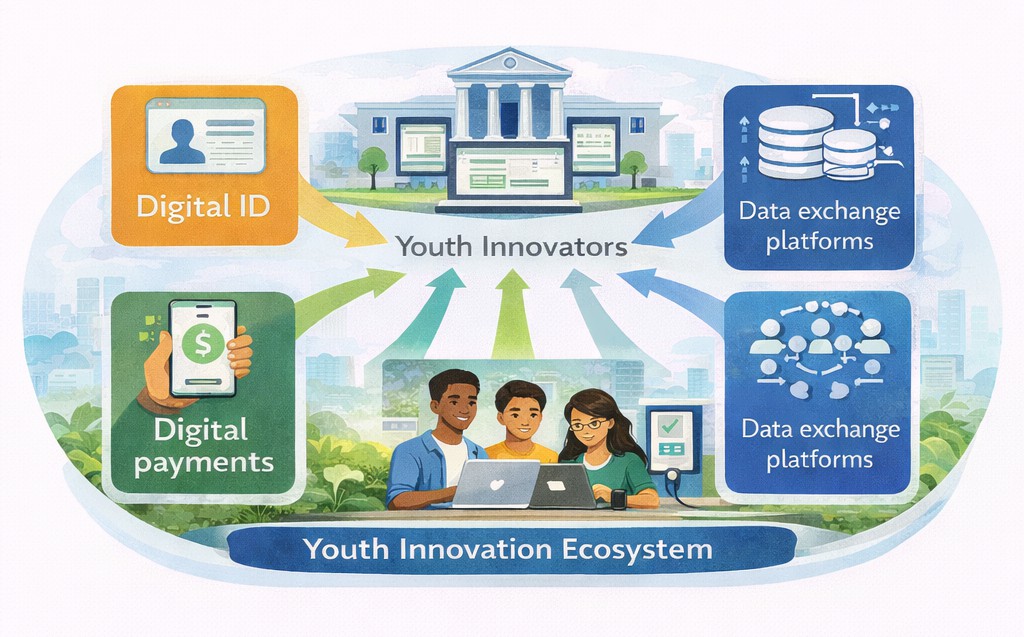
To clarify how youth-driven digital innovation is structurally enabled, figure 2 presents a conceptual representation of a youth innovation ecosystem built upon core components of digital public infrastructure (DPI). The figure illustrates how foundational DPI layers, such as digital identity, payment systems, government service portals and shared data protocols, interact to create an enabling environment within which young innovators can design, test and scale digital solutions. These layers collectively lower transaction costs, improve access to services and data, and facilitate collaboration between young people, public institutions and markets. The framework operationalizes the notion of youth-led digital innovation as infrastructure by showing how technological building blocks support sustained innovation capacity rather than isolated applications.
Youth-led innovations in AI and data analytics are also contributing to infrastructure-like services. AI chatbots and mobile platforms created by young developers are enhancing public-service delivery at scale. In South and South-East Asia, youth innovators have developed systems using machine learning to support flood forecasting, agricultural advisories and community-level climate-risk information (UNDP Viet Nam, 2025; ESCAP, 2024). These AI-driven services operate as digital infrastructure by providing timely information and analysis on which communities rely for livelihoods and safety. Importantly, many solutions use open-source data and emphasize interoperability, enabling transfer across regions, a hallmark of effective infrastructure. For example, youth-led climate-smart agriculture platforms increasingly combine low-cost sensing and AI analytics to generate actionable recommendations for smallholders, functioning as a digital extension layer for rural services (ESCAP, 2024; UNDP, 2024).
This framing also implies durability and scalability. Encouragingly, youth-led initiatives in the Asia-Pacific region show potential for both. Many began as pilot projects or hackathon prototypes and have grown into sustained operations or social enterprises. Their scalability is often supported by the low marginal cost of digital services, especially when delivered via mobile platforms and cloud infrastructure. However, scale alone is insufficient. Lasting impact depends on institutional embedding, where public agencies adopt youth-built systems, integrate them into service delivery and align with national digital strategies such as digital public infrastructure. DPI is increasingly recognized as a foundational approach to building interoperable, reusable digital systems that Governments and societies can build upon (World Bank, 2025). Recognizing youth-led innovation as infrastructure aligns with global efforts to build inclusive digital public goods and achieve SDG 9 (industry, innovation and infrastructure) and SDG 17 (partnerships for the Goals).
In summary, youth-driven digital innovations in AI, data platforms and digital twins are increasingly fundamental to sustainable development. They act as infrastructure enablers by providing new channels for service delivery, optimizing resource management and connecting stakeholders into functional networks. Recognizing them as infrastructure urges policymakers and institutions to invest in their interoperability, governance and long-term sustainability, as well as to nurture the talent behind them. The following sections examine enabling policy and institutional mechanisms — and where gaps remain.
3. Policy, institutional and technology-transfer mechanisms
Transforming youth-led innovations into durable infrastructure demands a supportive ecosystem, in particular one that spans ideation, piloting, institutional embedding and transnational scaling. In the Asia-Pacific region, several policies and institutional mechanisms have begun to facilitate this process, though persistent shortcomings remain.
3.1 Policy frameworks and regulatory environment
An inclusive and flexible policy environment is paramount. Governments in the region increasingly acknowledge young people as key stakeholders in innovation policy. Including young people in digital strategy and policymaking can result in more youth-sensitive, responsive policies (ESCAP, 2024). Some initiatives explicitly aim to amplify youth participation and build digital capacity for climate action, including efforts targeted at digitally empowering girls and young women in remote regions. Such approaches integrate innovation policy with equity objectives, ensuring that digital strategies prioritize gender, geography and access.
On the regulatory front, many young entrepreneurs struggle with complex rules not designed for digital start-ups. Flexible mechanisms such as regulatory sandboxes can help. Sandboxes allow innovators to pilot new technologies under supervised conditions, enabling iteration while regulators learn and adapt rules for emerging technologies. Guidance on sandbox design emphasizes the need for clear scope, safeguards, evaluation criteria and pathways for successful pilots to transition into mainstream compliance frameworks (CGAP, 2020). While sandboxes are often associated with financial technology, their logic can be extended to climate-tech, energy-tech and public-interest AI.
3.2 Institutions: education, incubation and collaboration
Educational institutions play a dual role as skill-builders and innovation hubs. Interdisciplinary innovation laboratories and challenge-based learning help students develop practical solutions for real-world sustainability problems. Across the region, universities are establishing accelerators and technopreneurship programmes focused on sustainable development. Incubation support can include mentorship networks, prototyping facilities, legal guidance and connections to investors, elements that youth innovators often lack (World Bank, 2020; UNESCO, 2024).
Beyond universities, dedicated youth incubators and hubs have proliferated across the Asia-Pacific region, ranging from government-funded centres to non-governmental organizations and private-sector laboratories. These institutions help reduce the networking and information barriers that young people face, providing pathways to partnerships, customers and capital (UNDP, 2024; UNDP, 2019). They also enable peer learning across cohorts and geographies, accelerating the diffusion of workable models. Where youth-led solutions align with DPI components — for instance, open-data protocols or shared digital identity — they are more likely to scale sustainably.
3.3 Technology-transfer and collaboration mechanisms
Technology transfer for youth innovation occurs through knowledge exchange, open-source platforms, partnerships and institutional adoption. Cross-border innovation challenges and youth forums are venues where young innovators showcase solutions to peers and potential adopters from other countries. International organizations contribute by documenting cases and disseminating good practices (ESCAP, 2024; UNDP, 2024). Corporate partnerships can scale youth innovations via technology licensing, integration into supply chains, or collaboration with utilities and public agencies.
However, gaps remain in the form of institutional silos, weak public-procurement channels, data-access constraints and limited support for intellectual property and standards adoption. Addressing these gaps requires institutional coordination, strengthening procurement for innovation, interoperability standards and cross-border alignment with DPI frameworks.
4. Case studies: youth-driven digital solutions
To ground the discussion in real-world outcomes, this section presents three in-depth case studies of youth-led digital innovation advancing sustainable development. Figure 3 visually summarizes these examples, which span climate-smart agriculture, community-based water governance and AI-enabled emergency response. Together, they illustrate how youth-led platforms operationalize core digital technologies, such as mobile applications, AI and open data systems, into practical services that deliver sustainability outcomes across agri-food systems, energy access, disaster-risk management and water governance.
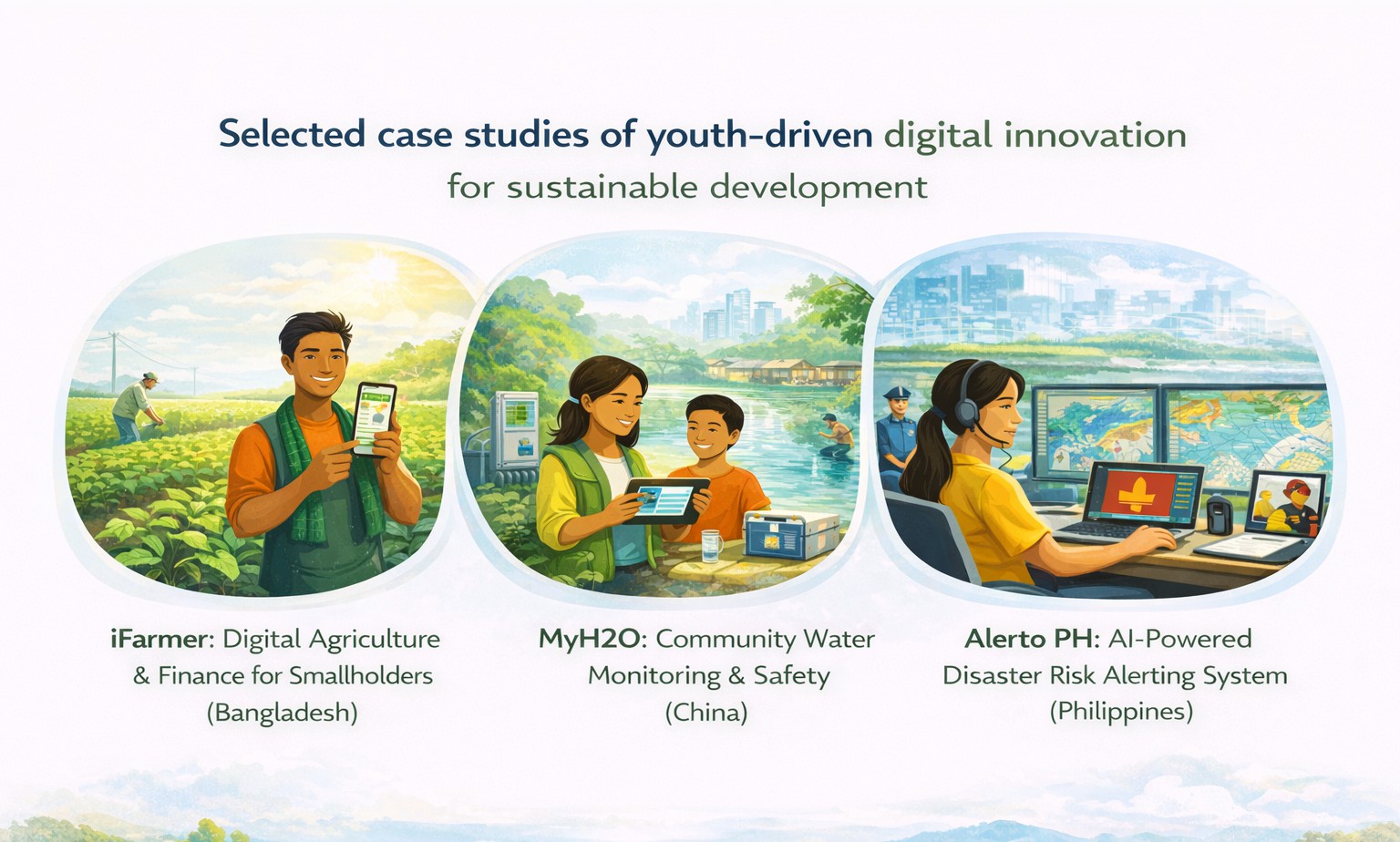
The first case study highlights how digital platforms can address productivity, finance and market-access gaps for small-scale farmers. The second examines citizen science and mobile technologies that improve transparency in rural water governance. The third explores sensor-integrated AI systems for disaster preparedness and response in urban environments. Collectively, these initiatives exemplify how youth-led innovation ecosystems convert digital infrastructure into scalable, mission-driven services that align with the Sustainable Development Goals.
4.1 Case study 1 — iFarmer: a technology platform enabling profit maximization for small-scale farmers (Bangladesh)
iFarmer is a youth-led digital agri-fintech platform launched in Bangladesh in 2019. It connects smallholder farmers to finance, inputs, advisory services and structured markets through mobile and web-based systems (Future Startup, 2020; iFarmer, 2024). By addressing constraints such as limited access to finance, information asymmetries and inefficient market structures, digital platforms contribute to higher productivity and income generation in rural areas. Through improved connectivity, access to services and market integration, they also support more inclusive and resilient economic outcomes (World Bank, 2022). As a platform delivering public-interest outcomes, iFarmer demonstrates how youth-built platforms can function as enabling infrastructure for development and support policy discussions on strengthening youth innovation ecosystems and digital inclusion aligned with SDGs 2, 8, 9 and 13 (UNCDF, 2023).
4.2 Case study 2 — MyH2O: a digital innovation supporting rural water governance (China)
MyH2O is a youth-driven citizen-science initiative in China launched in 2015. It mobilizes students and volunteers to collect water-quality data in rural areas, uploading results to an open-access platform that addresses persistent data gaps in water governance (UNEP, 2020). Local governments and non-governmental organizations use the data for planning and monitoring, while the platform also connects underserved communities with potential service providers (Wang, 2021; Chen, 2019). MyH2O exemplifies how youth engagement and open digital systems can complement public infrastructure in environmental monitoring, contributing to SDG 6 and SDG 17.
4.3 Case study 3 — Alerto PH: AI-enabled emergency alerting and response for local government units (Philippines)
Alerto PH is a woman-led Filipino start-up that provides an AI-powered emergency alert system for disaster-prone communities. First operational in 2025, the platform integrates mobile applications, sensors (e.g., flood, smoke and gas) and automated alerting into a decentralized emergency-response network (Mondares, 2025). Its back-end command system uses AI for real-time data processing and coordination with local government units, enhancing situational awareness and response speed (Apple App Store, 2025; Department of Science and Technology, 2025). The platform is available publicly via application stores and is being deployed in collaboration with national agencies (Alerto PH, 2025; Google Play, 2026).
Alerto PH operates as civic digital infrastructure: (i) integration infrastructure linking heterogeneous IoT devices; (ii) information infrastructure enabling real-time awareness; and (iii) coordination infrastructure connecting responders to incidents. Its scaling is enabled by device interoperability and public-agency adoption, but challenged by procurement fragmentation, connectivity gaps and data-governance risks. It advances SDGs 9, 11 and 13 by strengthening digital resilience to disasters and climate shocks.
5. Barriers to scaling youth innovation
Despite compelling examples, youth-led digital innovations face structural constraints that prevent them from scaling into durable and inclusive infrastructure. These barriers are multidimensional and span regulation, finance, access and inclusion, often mutually reinforcing each other and disproportionately affecting early-stage innovators.
5.1 Regulatory and bureaucratic complexity
Many regulatory environments in the Asia-Pacific region remain designed for established firms and legacy technologies. Young innovators must often navigate unclear rules on data governance, AI accountability or sector-specific compliance (e.g., energy, health and agriculture). These burdens can delay or derail early-stage deployment. In the absence of adaptive mechanisms such as regulatory sandboxes, youth-led teams are frequently expected to meet full compliance requirements prematurely, thus undermining their capacity to iterate and scale (CGAP, 2020; UN DESA, 2025).
5.2 Funding gaps and financial barriers
Access to finance is a persistent obstacle. Youth-led ventures commonly lack credit histories, formal registration or investor networks. This limits their eligibility for public funding and deters private investment, especially for solutions with public-good characteristics. As a result, many innovations remain trapped in the pilot stage, without resources to scale infrastructure, strengthen governance or sustain operations (UNDP, 2024; World Bank, 2020).
5.3 Infrastructure disparities and the digital divide
Scaling digital solutions requires foundational enablers such as reliable Internet, stable electricity and access to devices. In rural and underserved areas, these enablers are often absent or unevenly distributed. Digital-literacy gaps further constrain adoption. Without these basic infrastructure layers, identified in figure 1, higher-order innovations cannot scale equitably. These divides are often exacerbated by broader patterns of socioeconomic inequality and geographic isolation.
5.4 Networking, mentorship and market access
Youth-led teams frequently lack access to mentorship, institutional partners and procurement pathways. Weak connections to anchor customers, such as local governments, utilities or development agencies, limit the embedding of youth innovations into public systems. Difficulty navigating procurement processes and enterprise channels also hinders scaling and sustainability (UNDP, 2024). Strengthening ecosystem linkages is thus critical for overcoming fragmentation.
5.5 Gender and social inclusion barriers
Systemic inclusion barriers persist across the innovation life cycle. Young women and marginalized groups often face obstacles in education, entrepreneurial support and investment access. Without deliberate interventions, such as gender-sensitive procurement, targeted digital-skills programmes and safe innovation spaces, youth-led innovation ecosystems risk reinforcing exclusion. Inclusive AI and equitable governance frameworks are essential for broadening participation and ensuring that benefits are fairly distributed (UNCTAD, 2025; ESCAP, 2024).
6. Recommendations: strengthening youth innovation ecosystems
Overcoming the barriers outlined above and amplifying the systemic impact of youth innovation requires coordinated action across institutions. The following recommendations are designed to transition youth-led solutions from isolated pilots to scalable, transferable and embedded infrastructure for sustainable development.
6.1 Governments and policymakers
Governments should: (i) invest in foundational digital enablers, such as connectivity, digital literacy and open-data access, to reduce structural inequities; (ii) expand adaptive regulatory mechanisms, including sandboxes for climate-tech, energy-tech and public-interest AI; (iii) institutionalize innovation-oriented public procurement to stimulate demand for youth-driven solutions; and (iv) align national digital and sustainability strategies with the principles of digital public infrastructure (World Bank, 2025; OECD, 2017; OECD, 2023).
6.2 Universities and educational institutions
Universities should embed challenge-based learning, interdisciplinary laboratories and translational research pathways that connect students to real-world problem-solving. Institutions should foster inclusive STEM and digital-skills pipelines for women and marginalized young people, linking education with incubation, partnerships and deployment opportunities (UNESCO, 2024; World Bank, 2020).
6.3 Incubators, accelerators and innovation hubs
Innovation hubs should provide comprehensive support in the form of mentorship, prototyping facilities, investor access and regulatory navigation. Programmes must intentionally broaden inclusion through scholarships, dedicated cohorts and gender-responsive mentorship. They should also promote interoperability and standards adoption, enabling youth-built solutions to integrate with government and enterprise systems.
6.4 Private sector and industry
Private companies can strengthen youth innovation ecosystems by engaging in open-innovation partnerships, adopting youth-developed solutions, offering mentorship and providing catalytic venture funding. Embedding these solutions in supply chains and service models accelerates scaling and commercial viability, especially when aligned with corporate sustainability goals.
6.5 International organizations and development partners
Development actors should: (i) facilitate cross-border knowledge exchange and peer learning; (ii) document replicable good practices and support regional technology transfer; (iii) invest in pilot-to-scale mechanisms and innovation infrastructure; and (iv) strengthen governance capacity for inclusive, responsible AI and digital transformation in development contexts (UNCTAD, 2025; UNDP, 2024; ESCAP, 2024).
7. Conclusion
Youth-led digital innovation is emerging as a critical driver of sustainable development, functioning not merely as a collection of individual applications but as an evolving layer of enabling infrastructure. In the Asia-Pacific region, where young people comprise a majority demographic and digital adoption is accelerating, these innovations offer tangible solutions to long-standing challenges in climate resilience, agriculture, public-service delivery and disaster preparedness.
This article has conceptualized youth-driven digital innovation as a layered infrastructure system: built upon foundational enablers such as connectivity and skills; structured through core digital components, including AI, data platforms and digital twins; applied via youth-led solutions; and institutionalized through policy and procurement mechanisms. Through illustrative case studies, from agri-fintech in Bangladesh to citizen science in China and AI-enabled emergency systems in the Philippines, the authors have demonstrated how young people are transforming abstract technologies into practical services that advance multiple Sustainable Development Goals.
However, realizing the full potential of this transformation depends on overcoming systemic barriers. Regulatory rigidity, financial exclusion, infrastructure disparities and inclusion gaps all constrain the scalability and durability of youth-led initiatives. These barriers are not incidental, as they reflect deeper asymmetries in how innovation ecosystems are structured and resourced. Without intervention, even the most promising pilots risk stagnation or fragmentation.
The policy recommendations offered in this article emphasize the need for ecosystemic approaches. Governments must institutionalize innovation-oriented procurement and adaptive regulation. Universities should integrate inclusive digital-skills training with challenge-based, interdisciplinary innovation models. Incubators and hubs must go beyond access to facilities by supporting interoperability, investment readiness and equity. Private firms and development partners have essential roles in embedding and scaling youth-built solutions, especially those delivering public goods.
Looking ahead, three key priorities stand out. First, youth-led digital innovation must be anchored in robust digital public infrastructure: open, reusable systems that lower the entry cost for new innovators and ensure continuity. Second, inclusion must move from rhetoric to design principle, shaping funding models, capacity-building and governance. Third, research and evidence gaps persist. In particular, better metrics are needed to assess the long-term impact of youth-led digital solutions, as well as comparative studies on ecosystem models that enable successful scaling.
If supported with the right policies, institutions and infrastructure, young innovators can become central architects of a more resilient, equitable and sustainable future. Investing in youth-led digital ecosystems is a strategic route to better public services — provided that Governments institutionalize adoption pathways, safeguards and inclusion from the outset. In doing so, countries can accelerate progress towards achieving the Sustainable Development Goals, particularly those related to inclusive growth, resilient infrastructure, climate action and strengthened partnerships.
Technology offer
Interested in this technology?
Request further information or explore potential cooperation with the technology provider.
Technology request
Can you help meet this technology need?
Share a relevant technology, expertise or partnership opportunity with APCTT.