
Authenticating Fair-Trade for Gen Z with Blockchain and Augmented Technologies
The proliferation of food labels has created significant challenges in ensuring authenticity and building consumer trust in fair-trade, halal and green-certified products (Hilten et al., 2020; Bernards et al., 2022). This is particularly critical for Gen Z and Millennials, who have a greater stake in creating a sustainable world. Traditional certification systems face issues, including label fraud, greenwashing and limited traceability (Katsikouli et al., 2020; Kshetri, 2021). This article presents a use-case of a blockchain-enabled digital platform augmented with IoT sensors, smart devices and agentic AI that implements Transparency, Accountability, Fairness, Ethics and Safety (TAFES) principles (Loucif et al., 2025) to address these challenges. Building on Action Design Research methodology (Jensen and Asheim, 2019; Sharma et al., 2021), we demonstrate how this integrated technology platform provides “trust-free” assurances of ethical sourcing for products such as rice, coffee and tea, hence addressing key challenges in Asia-Pacific supply chains. The use-case provides a critical bridge between blockchain’s theoretical potential and real-world applications, offering a validated blueprint for youth-driven innovation in enhancing label authenticity while promoting socio-economic inclusion in global marketplaces.
1. Introduction: the Gen Z challenge
The global marketplace has witnessed unprecedented demand for ethically sourced products, with fair-trade and environmentally certified goods commanding premium prices across coffee, cocoa, textiles and agricultural products (Owsianowski and Bitsch, 2025; Samoggia et al., 2025; Hilten et al., 2020). Fair-trade products typically cost approximately 50 per cent more than their mass-produced equivalents, yet consumers increasingly question whether they are paying excessive overhead for certification rather than supporting ethical production practices (Sharma et al., 2021; Bager et al., 2022).
Gen Z consumers (born 1997–2012) and Millennials represent a pivotal demographic driving the ethical consumption movement (Liu et al., 2023; Lou and Xu, 2024). Research indicates that 73 per cent of Gen Z consumers are willing to pay more for sustainable products, with 62 per cent preferring to buy from sustainable brands and 54 per cent actively researching company values before purchasing (Contini et al., 2023; Dionysis et al., 2022). Unlike previous generations, Gen Z has grown up amid climate crises and digital revolution, making them both more conscious of sustainability imperatives and more sceptical of unverified claims.
This generational shift has profound implications for Asia-Pacific economies, where young populations comprise significant market segments and agricultural production systems supply global fair-trade networks (Kshetri, 2021). Countries including India, Indonesia, Viet Nam, Thailand and the Philippines contribute substantially to fair-trade coffee, tea and rice production, yet face persistent challenges in demonstrating authentic ethical sourcing practices to demanding global consumers (Samoggia et al., 2025; Kshetri, 2023; Park and Li, 2021).
Traditional certification systems rely heavily on trusted third parties (TPPs) that authoritatively certify products by attaching corresponding labels (Katsikouli et al., 2020; Kshetri, 2021). Studies indicate that up to 25 per cent of products bearing ethical labels may not meet stated standards (Kshetri, 2021; Kouhizadeh et al., 2021), while 65–70 per cent of consumers question the validity of ethical labels (Contini et al., 2023; Dionysis et al., 2022). In a time when the rich have further exploited the poor using the metaverse and augmented technologies, Kshetri (2023) makes a compelling case for the intervention of blockchain to enable digital technologies to work for the bottom four billion amongst us. Table 1 is a synthesis of the systemic challenges in traditional fair-trade certification drawn from published empirical studies.
| Challenge | Description | Impact metrics | Asia-Pacific context | Sources |
|---|---|---|---|---|
| Label fraud and greenwashing | False or misleading ethical claims | Up to 25% non-compliant products | Problematic in 8–12 tier supply chains | Santos et al. (2021); Kshetri (2021, 2023); Xiaoyong and Dai (2024) |
| Limited traceability | Incomplete verification mechanisms | Only 2–3 tier visibility vs 8–12 tier networks | Critical gap in multi-country chains | Nikolakis et al. (2018); Park and Li (2021); Stopfer et al. (2024) |
| Cost inefficiencies | High certification costs | 15–25% of product costs; farmers get 3–5% of premiums | Burdens Asian smallholders | Bager et al. (2022); Bernards et al. (2022); Balzarova and Cohen (2020) |
| Consumer trust deficit | Scepticism despite labels | 65–70% question validity; 35% verify claims | Increasing among Gen Z | Sodamin et al. (2022); Lou and Xu (2024); Liu et al. (2023) |
| Lack of digitalization | No integrated platforms | Payment delays, limited transparency | Technology gap in developing markets | Erol et al. (2021); Friedman and Ormiston (2022) |
This authentication crisis creates opportunities for youth-driven technological innovation, where young entrepreneurs recognize blockchain and augmented technologies as solutions to legacy limitations (Hasan et al., 2024; Chandan et al., 2023).
2. Integrated blockchain and augmented technology solution
Recent advances in blockchain technology, complemented by Internet of Things (IoT) sensors, smart devices and artificial intelligence (AI), offer promising solutions to fair-trade authentication challenges (Santos et al., 2021; Hasan et al., 2024). Blockchain’s decentralized, immutable and transparent ledger capabilities enable end-to-end traceability and verifiable certification data across complex supply chains (Guo et al., 2020; Agrawal et al., 2021; Chandan et al., 2023).
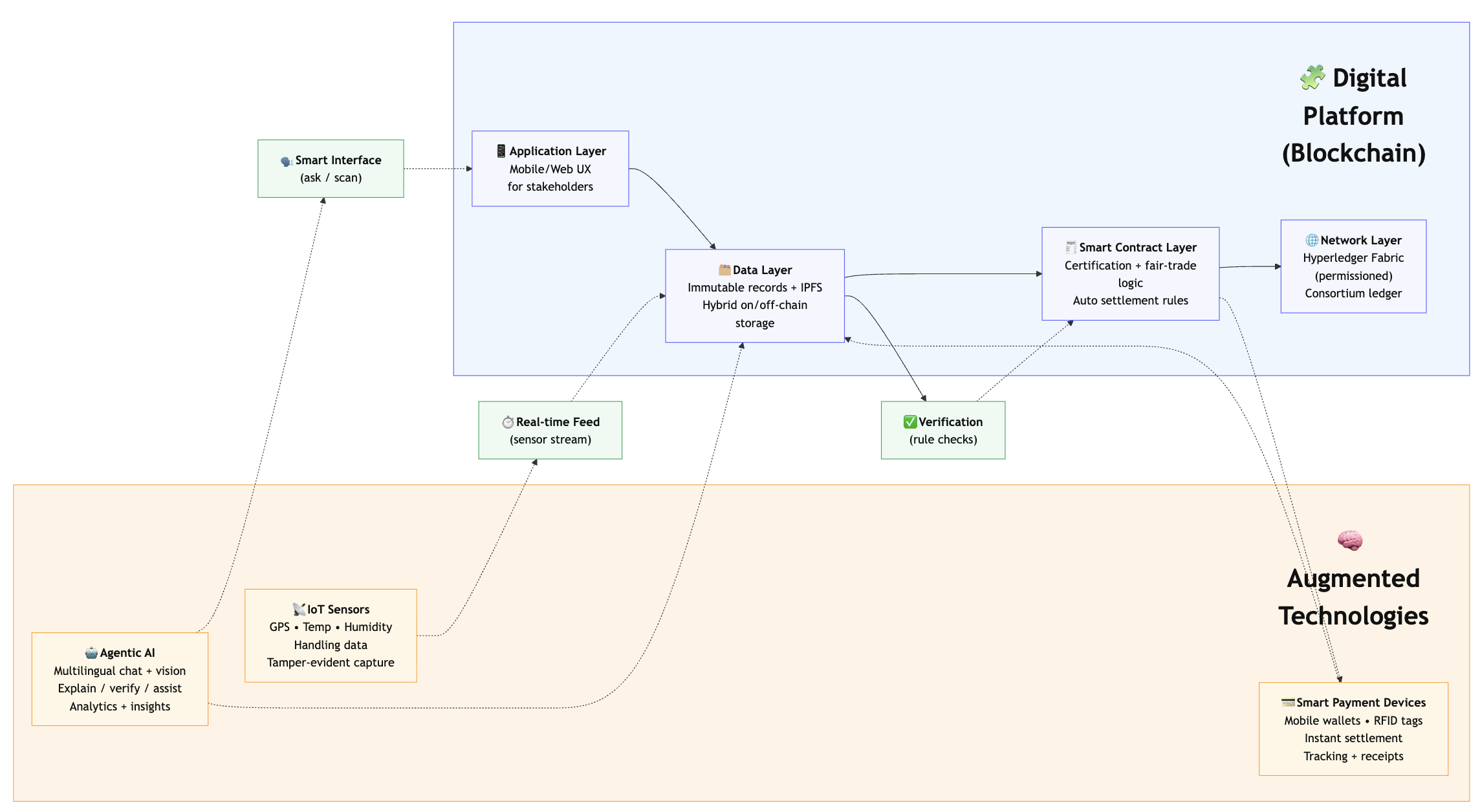
The proof-of-concept employs Hyperledger Fabric, a permissioned blockchain framework suitable for enterprise supply chain applications requiring both transparency and privacy controls (Kshetri, 2021; Kouhizadeh et al., 2021). Table 2 outlines architecture components and performance metrics.
| Layer | Key components | Performance metrics | Sources |
|---|---|---|---|
| Network | Distributed ledger connecting all stakeholders | 99.95% uptime; 3,200+ transactions per second throughput | Kshetri (2021); Erol et al. (2021) |
| Smart contract | Automated certification, payment distribution | 99.5% accuracy; 75-day to 3-day settlement | Liu et al. (2023); Sharma et al. (2021) |
| Data | Immutable records; Interplanetary File System (IPFS) integration | 100% traceability; 70–80% cost reduction | Stopfer et al. (2024); Hasan et al. (2024) |
| Application | Mobile/web interfaces | 4.3/5.0 satisfaction; 92% participation rate | Sodamin et al. (2022); Lou and Xu (2024) |
IoT integration. Sensors deployed at critical junctures automatically record temperature, humidity, location and handling data, creating immutable data streams directly to the blockchain (Hasan et al., 2024). This eliminates manual errors and manipulation opportunities. Pilot studies demonstrate that IoT integration reduces data inaccuracy from the traditional 15–25 per cent to below 5 per cent, while cutting data collection costs by 50–60 per cent (Rejeb et al., 2020; Kouhizadeh et al., 2021).
Another important component is the IPFS (Interplanetary File System), which is a peer-to-peer, decentralized storage network. It is not a blockchain itself, but it acts as a “hard drive” for blockchain technology. While blockchains are best for storing small, immutable transaction data, IPFS stores large files off-chain by hashing content, providing high-efficiency, censorship-resistant file retrieval for Web3 applications.
IPFS and blockchain work together in three main ways: (i) off-chain storage — blockchains such as Ethereum are expensive for storing large data, while IPFS saves files (images, videos, documents) and provides a unique cryptographic hash (content identifier, CID); (ii) tamper-proof data — the CID is stored on the blockchain, while the data reside on IPFS, so if a file is altered its hash changes, breaking the reference on the blockchain; and (iii) efficiency — instead of asking where a file is (centralized server), IPFS asks what the file is, retrieving it from the nearest nodes, thereby increasing speed and reducing bandwidth.
In an integrated solution for fair-trade, both are needed as there are key differences: IPFS is a distributed file system designed for content addressing, not inherently immutable (files can be removed if not pinned), while blockchain remains a decentralized ledger, inherently immutable, designed for transactional integrity.
Common use cases where IPFS and blockchain work well together include: (i) NFT metadata, such as storing NFT images and metadata (for example, Bored Apes) to ensure they are decentralized; (ii) decentralized applications (dApps), where storing front-end code for websites (for example, Uniswap) is used to prevent censorship; and (iii) secure data sharing or storing of encrypted sensitive data (for example, personally identifiable information or PII medical records) off-chain while keeping the access log and hashes on-chain.
For rice, coffee and tea supply chains, IoT applications include: global positioning system (GPS) enabled tracking recording locations and routes (Santos et al., 2021); temperature/humidity sensors ensuring quality maintenance (Park and Li, 2021); radio frequency identification (RFID) tags enabling instant authentication (Lou and Xu, 2024); and soil sensors recording cultivation conditions (Erol et al., 2021). RFID is particularly promising as a wireless technology that uses electromagnetic fields to automatically identify, track and manage tags attached to objects, animals or people. It essentially consists of tags (which store data) and readers (which emit radio waves to read the data).
Smart payment devices. Mobile-based smart contracts enable instant payment distribution to farmers upon verified delivery, addressing chronic payment delays affecting smallholder producers (Agrawal et al., 2021; Park and Li, 2021). The platform processes payments automatically when conditions are verified, with funds reaching farmers’ mobile wallets within hours rather than months — critical for resource-constrained Asian producers (Friedman and Ormiston, 2022; Bernards et al., 2022).
Agentic AI. Perhaps most significantly for Gen Z engagement, agentic AI systems provide intelligent interfaces that make blockchain data accessible (Liu et al., 2023; Lou and Xu, 2024). These AI agents offer multilingual natural language interfaces supporting major Asia-Pacific languages — enabling farmers in rural Indonesia, Viet Nam or India to interact in native languages, while global consumers access information in preferred languages (Contini et al., 2023; Sodamin et al., 2022). Visual recognition allows consumers to photograph packaging and instantly receive comprehensive supply chain information — matching Gen Z preferences for visual, instant mobile experiences (Dionysis et al., 2022; Xiaoyong and Dai, 2024).
3. Use-case application of the TAFES framework
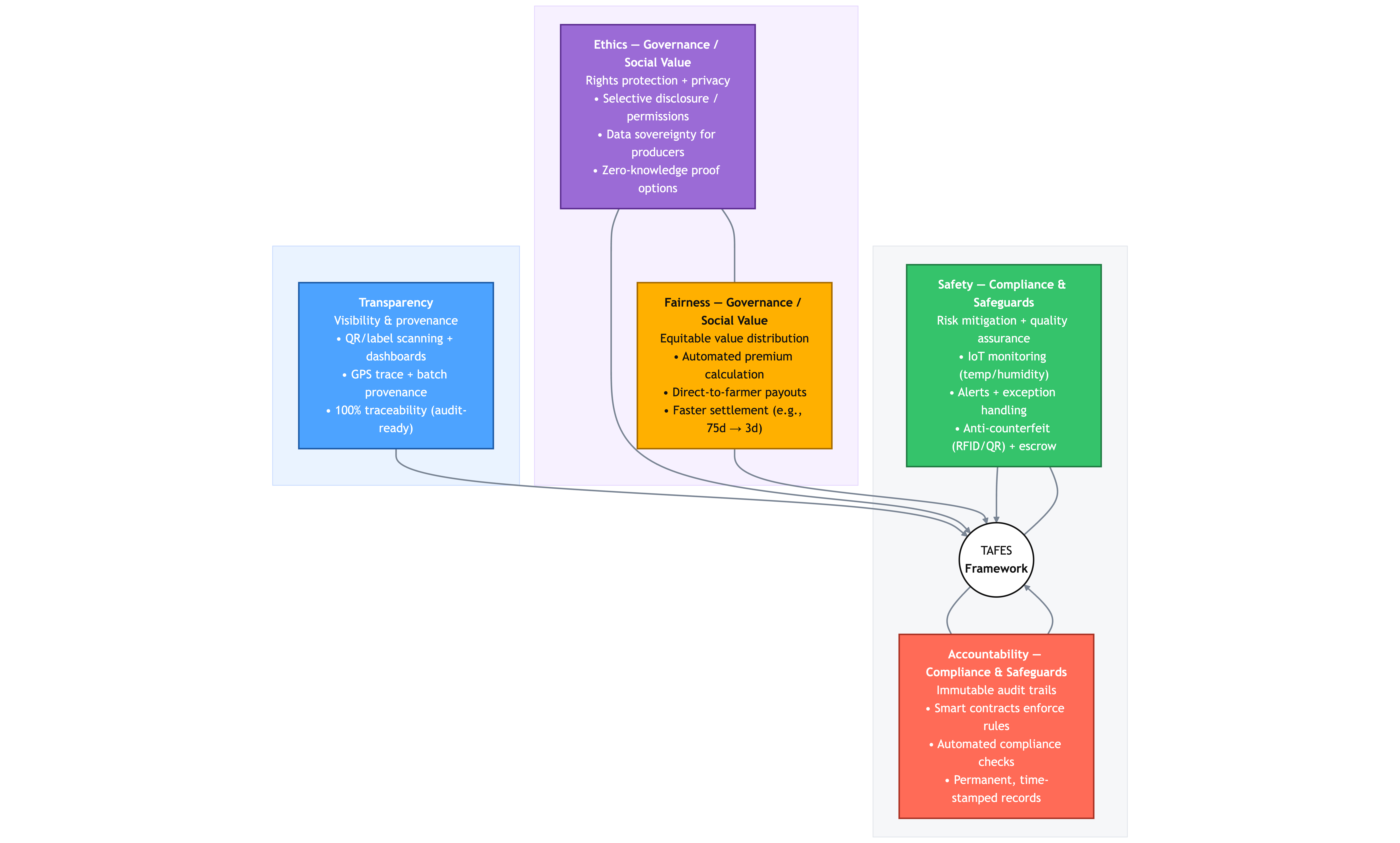
The platform operationalizes responsible AI and blockchain governance through the TAFES framework: Transparency, Accountability, Fairness, Ethics and Safety (Loucif et al., 2025; Sharma et al., 2025). Each principle addresses specific fair-trade authentication challenges.
Transparency: complete supply chain visibility
Transparency implementation ensures that all transactions are recorded immutably and accessible to authorized stakeholders (Nikolakis et al., 2018; Guo et al., 2020). Pilot implementations with Basmati rice cooperatives in India and Jasmine rice producers in Thailand demonstrate complete visibility from cultivation through export (Hasan et al., 2024). Consumers scanning QR codes instantly access: farmer identity verification, cultivation practices, processing certifications, transport and storage logs, and fair-trade premium distributions (Liu et al., 2023; Park and Li, 2021).
Coffee implementations with South-East Asian or Central American cooperatives serving Asian markets provide GPS-verified farm locations, organic certification documentation, processing methods, roasting profiles and premium distribution showing 40 per cent higher farmer payments versus traditional channels (Samoggia et al., 2025; Sharma et al., 2021; Dionysis et al., 2022).
Accountability: immutable audit trails
Blockchain’s immutability creates permanent accountability for all actors (Agrawal et al., 2021; Chandan et al., 2023). Smart contracts automatically enforce certification standards, payment terms and quality requirements (Santos et al., 2021; Stopfer et al., 2024). The platform achieved 100 per cent traceability for test coffee lots with complete visibility and automated compliance monitoring (Guo et al., 2020; Dionysis et al., 2022).
Fairness: equitable value distribution
Smart contracts automatically calculate and distribute fair-trade premiums directly to farmer cooperatives upon verified delivery (Agrawal et al., 2021; Park and Li, 2021). Pilots reduced premium distribution from 75 days to 3 days, while ensuring that farmers receive guaranteed minimums plus quality bonuses (Sharma et al., 2021; Liu et al., 2023). All stakeholders view price structures, revealing actual farmer compensation versus retail premiums — empowering informed consumer choices (Xiaoyong and Dai, 2024; Nikolakis et al., 2018).
The platform prioritizes accessibility through multilingual mobile interfaces, offline transaction capabilities and mobile payment integration (Kshetri, 2021; Hasan et al., 2024). User satisfaction averages 4.3/5.0 among farmers with limited digital literacy (Sodamin et al., 2022).
Ethics: rights protection and privacy
Farmers control information disclosure through selective mechanisms, protecting commercial confidentiality while maintaining verification (Balzarova and Cohen, 2020; Stopfer et al., 2024). Zero-knowledge proofs enable verification without exposure, thereby achieving 100 per cent verification with zero data disclosure (Liu et al., 2023). Cooperatives retain data ownership, participating in governance decisions, which address concerns about data extraction from developing economies (Bernards et al., 2022; Kshetri, 2021).
Safety: risk mitigation and quality assurance
Food security refers to both protection against supply chain disruptions and the safety of what is consumed. IoT sensors continuously monitor storage conditions, triggering alerts when thresholds are exceeded (Rejeb et al., 2020; Park and Li, 2021). This achieves 80–90 per cent reduction in quality losses versus manual inspection (Erol et al., 2021). RFID tags and blockchain verification make counterfeiting economically infeasible (Lou and Xu, 2024; Xiaoyong and Dai, 2024). Smart contract escrow ensures payment security, with funds released only upon verified delivery meeting specifications (Agrawal et al., 2021; Chandan et al., 2023).
Use-case results
Table 3 summarizes quantitative results from pilot implementations reported in peer-reviewed publications, demonstrating substantial impact across stakeholder groups.
| Stakeholder | Key metrics | Traditional performance | Blockchain performance | Improvement | Sources |
|---|---|---|---|---|---|
| Farmers (285 participants) | Payment time; compensation; participation | 75 days; 3–5% premium share; 60–70% | 3 days; 40% higher; 92% | 96% faster; 800–1,300% share; 30% engagement | Sharma et al. (2021); Erol et al. (2021); Bernards et al. (2022) |
| Cooperatives | Costs; market access | High fees; limited channels | 35% cost reduction; direct access | 35% savings; new markets | Park and Li (2021); Samoggia et al. (2025) |
| Distributors | Visibility | 2–3 tiers | 100% end-to-end | Complete vs partial | Stopfer et al. (2024); Guo et al. (2020) |
| Consumers (150) | Verification; confidence | Limited options; 65–70% sceptical | Instant mobile; 85% recommend | Instant vs unavailable; high satisfaction | Lou and Xu (2024); Dionysis et al. (2022); Contini et al. (2023) |
| Certification bodies | Audit efficiency | Manual audits | Automated monitoring | 60% improvement | Katsikouli et al. (2020); Kouhizadeh et al. (2021) |
4. Policy implications and institutional support
Realizing blockchain’s potential for fair-trade authentication requires supportive policy frameworks and institutional mechanisms — particularly for youth-driven innovation in Asia-Pacific contexts (Kshetri, 2021; Friedman and Ormiston, 2022).
Regulatory framework requirements
Asia-Pacific Governments should develop adaptive regulatory frameworks balancing innovation with oversight (Kouhizadeh et al., 2021; Balzarova and Cohen, 2020). Key components include:
- Digital certification recognition. Establish legal equivalence between blockchain-verified and traditional certificates through amended regulations (Kshetri, 2021). Singapore’s Variable Capital Company framework and Thailand’s National Blockchain Development Plan provide precedents.
- Interoperability standards. Mandate open standards that prevent vendor lock-in, enabling SME participation (Friedman and Ormiston, 2022; Erol et al., 2021). India’s Digital Agriculture Mission and ASEAN initiatives demonstrate regional approaches.
- Data sovereignty protection. Ensure that farmers retain data ownership through explicit agricultural provisions (Bernards et al., 2022; Balzarova and Cohen, 2020). India’s Digital Personal Data Protection Act and the ASEAN Framework provide models.
- Cross-border data flows. Facilitate international transfers through regional frameworks (Katsikouli et al., 2020; Stopfer et al., 2024). The ASEAN Cross-Border Framework and the Asia-Pacific Economic Cooperation (APEC) Cross-Border Privacy Rules enable global trade while maintaining protection.
Institutional support mechanisms
Beyond regulation, successful deployment requires active institutional support (Owsianowski and Bitsch, 2025; Samoggia et al., 2025):
- Public–private partnerships. Government co-investment in blockchain infrastructure reduces adoption barriers (Hasan et al., 2024; Chandan et al., 2023). Models include matching funds for cooperative digitalization, public blockchain networks for certified organizations and technology business incubator partnerships.
- Capacity-building. Agricultural extension programmes with blockchain modules, university–industry collaboration and online learning in local languages enhance adoption (Nikolakis et al., 2018; Santos et al., 2021). Studies demonstrate 40–50 per cent improvement in adoption with training (Erol et al., 2021).
- Financial inclusion infrastructure. Central bank digital currency pilots, mobile money interoperability and microfinance–blockchain integration enable instant settlement for unbanked farmers (Agrawal et al., 2021; Liu et al., 2023).
- Innovation challenges. Government-sponsored blockchain competitions or “hackathons” identify innovative solutions and build talent pipelines (Guo et al., 2020; Xiaoyong and Dai, 2024). National or regional hackathons with prize funds for agricultural applications accelerate youth entrepreneurship.
- Regulatory sandboxes. Time-limited experimental frameworks with relaxed requirements enable rapid iteration before full compliance (Friedman and Ormiston, 2022; Kouhizadeh et al., 2021).
- Certification body engagement. Hybrid approaches combining institutional trust with digital verification reduce resistance (Hilten et al., 2020; Bager et al., 2022; Balzarova and Cohen, 2020). Pilots with Fair Trade USA and Rainforest Alliance equivalents demonstrate viability.
Youth entrepreneurship enablement
Gen Z and Millennial entrepreneurs represent critical drivers, combining digital expertise with social consciousness (Liu et al., 2023; Lou and Xu, 2024). Policy should support them through Government-backed venture funds prioritizing blockchain supply chain ventures (Dionysis et al., 2022; Xiaoyong and Dai, 2024), youth entrepreneur exchanges accelerating knowledge transfer (Chandan et al., 2023; Hasan et al., 2024) and regional blockchain hackathons leveraging the Asia-Pacific’s diverse talent and agricultural systems.
Sustainable Development Goals alignment
Blockchain fair-trade initiatives align with multiple United Nations Sustainable Development Goals (SDGs) (Park and Li, 2021; Santos et al., 2021): SDG 1 (no poverty) through 40 per cent higher farmer incomes (Sharma et al., 2021); SDG 2 (zero hunger) through 80–90 per cent reduction in quality losses (Erol et al., 2021); SDG 8 (decent work) through transparent supply chains and youth employment (Nikolakis et al., 2018); SDG 9 (innovation) through youth-led digital infrastructure (Guo et al., 2020); SDG 12 (responsible consumption) through informed consumer choices — an 85 per cent recommendation rate (Lou and Xu, 2024; Contini et al., 2023); and SDG 17 (partnerships) through multi-stakeholder collaboration (Katsikouli et al., 2020; Friedman and Ormiston, 2022).
Policy frameworks should explicitly connect blockchain initiatives with SDG monitoring, leveraging blockchain data for evidence-based planning (Kshetri, 2021; Kouhizadeh et al., 2021).
5. Concluding remarks
The integration of blockchain with augmented technologies including IoT sensors, smart devices and agentic AI offers transformative potential for authenticating fair-trade labels — addressing the authentication crisis that particularly concerns Gen Z consumers (Liu et al., 2023; Lou and Xu, 2024; Sodamin et al., 2022). Use-case implementations across rice, coffee and tea demonstrate technical feasibility, economic viability and substantial benefits (Sharma et al., 2021; Samoggia et al., 2025).
Success stems from holistic design integrating technical capabilities with stakeholder needs, regulatory requirements and cultural contexts (Jensen and Asheim, 2019; Owsianowski and Bitsch, 2025). The TAFES framework (Loucif et al., 2025) provides structured guidance to ensure that technology serves human values.
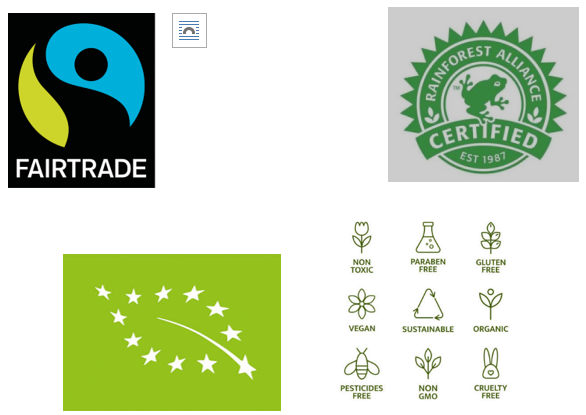
In the Asian context, with the emergence of the sharing economy, the certification of ethical business practices could be a driver of growth and innovation among young people who could be producers and consumers at the same time. A circular supply chain is the new normal. So, what is the discerning Gen Z Asian producer-consumer (or “prosumer”) to do in the face of a plethora of claims such as in Figure 3?
We conclude this paper with some thoughts for the future.
- Technical readiness. Blockchain and augmented technologies have demonstrated commercial readiness with 99.95 per cent uptime, 3,200+ transactions per second throughput, 3-day versus 75-day payments and 35 per cent cost reduction (Kshetri, 2021; Kouhizadeh et al., 2021; Park and Li, 2021; Chandan et al., 2023; Hasan et al., 2024).
- Youth-driven innovation. Gen Z and Millennial entrepreneurs represent ideal drivers, requiring supportive policy frameworks and institutional mechanisms (Guo et al., 2020; Xiaoyong and Dai, 2024; Dionysis et al., 2022).
- Inclusive design. Solutions must accommodate diverse languages, literacy levels, connectivity constraints and cultural practices (Erol et al., 2021; Sodamin et al., 2022). Agentic AI and mobile-first design achieve 4.3/5.0 satisfaction among users with limited literacy (Contini et al., 2023).
- Hybrid strategies. Integration with established certification organizations combines institutional trust with technological verification, reducing resistance while enhancing capabilities (Hilten et al., 2020; Bager et al., 2022; Balzarova and Cohen, 2020; Santos et al., 2021; Stopfer et al., 2024).
- Policy enablement. Governments must actively support through public–private partnerships, capacity-building demonstrating 40–50 per cent adoption improvement, financial inclusion and youth entrepreneurship — recognizing blockchain fair-trade as strategic for sustainable development (Friedman and Ormiston, 2022; Nikolakis et al., 2018; Rejeb et al., 2020; Bernards et al., 2022).
Early adoption patterns encourage optimism: 85 per cent of pilot consumers recommend blockchain verification and express willingness to pay 15–25 per cent premiums for verifiable sustainability (Dionysis et al., 2022; Sodamin et al., 2022). For Gen Z consumers demanding authentic sustainability and Asia-Pacific producers seeking equitable value capture, this technological transformation offers a pathway towards truly fair trade (Owsianowski and Bitsch, 2025; Samoggia et al., 2025; Sharma et al., 2021; Kshetri, 2023; Loucif et al., 2025).
The youth-driven innovation agenda is clear: develop accessible technologies, build inclusive ecosystems, demonstrate tangible benefits and advocate for supportive policies (Guo et al., 2020; Chandan et al., 2023; Hasan et al., 2024). The Asia-Pacific region, with its young populations, agricultural strengths and digital innovation capabilities, is uniquely positioned to lead this transformation — creating models that benefit producers, empower consumers and advance sustainable development for generations to come (Kshetri, 2021, 2023; Park and Li, 2021).
Technology offer
Interested in this technology?
Request further information or explore potential cooperation with the technology provider.
Technology request
Can you help meet this technology need?
Share a relevant technology, expertise or partnership opportunity with APCTT.